

Reviewed · HISTORICAL TOURS
Half-Day Historical Tour of Halifax
Halifax’s past is unusually concentrated: Titanic graves, the 1917 Halifax Explosion, naval forts, immigrant stories, and centuries-old churches all appear in a single day. Paul McNeil’s tour ties those stories together while driving through Halifax, Dartmouth, and Fisherman’s Cove.
I like the small group of no more than 10 people, which makes pickup and short stops easier than on a large coach. I also like the multimedia presentation in the van, where Paul uses photographs, videos, and a tablet to add faces and detail to the places outside the window.
The main thing to consider is the pace. This is largely a sightseeing drive with selected short walks, not a leisurely walking tour or museum visit. Cruise passengers should also confirm their ship’s departure time carefully, since a short port call may require skipping part of the route.
In This Review
- Key points to know before booking
- A history tour with more than the usual Halifax postcard
- Pier 21 and the waterfront story
- Breweries, ships, and maritime memory
- Historic buildings in the city center
- The Citadel and Halifax’s military clock
- Churches, cemeteries, and Halifax’s human stories
- Halifax Explosion and Titanic cemeteries
- Parks, universities, and views beyond downtown
- Dartmouth, lunch, and Fisherman’s Cove
- Comfort, timing, and practical value
- Who should book this Halifax tour?
- FAQ
- How long does the Half-Day Historical Tour of Halifax last?
- Where does the tour begin?
- How many people can join the tour?
- Is lunch included in the price?
- Is admission to Halifax Citadel included?
- What happens if I need to cancel?
- Should you book it?
Key points to know before booking

- Titanic and Halifax Explosion sites: Visit Fairview Lawn Cemetery, Mount Olivet Cemetery, the Mont Blanc anchor, and the Halifax Explosion Memorial Bell Tower.
- Paul McNeil’s local storytelling: Paul leads the tour himself and adds photographs and short video clips to the history.
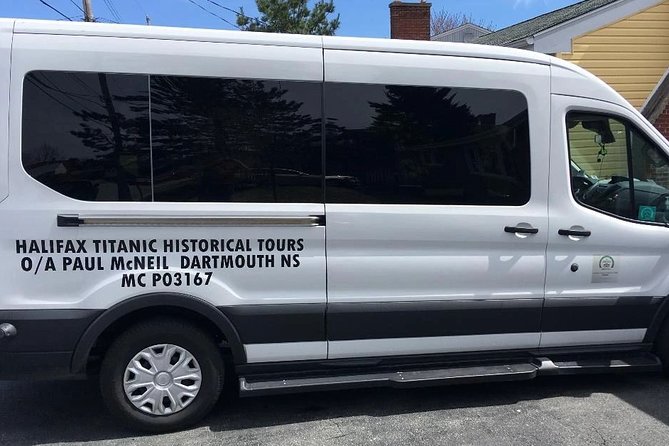
- Small-group transport: A Ford Transit 350 XLT high-roof van carries four to 10 people.
- Halifax plus Dartmouth: The route includes downtown landmarks, Point Pleasant Park, Lake Banook, The Dingle, and Fisherman’s Cove.
- Noon at the Citadel: The schedule is designed to reach Halifax Citadel for the noon gun and the changing of the guard.
- Lunch is extra: You can stop at Evan’s Seafood in Dartmouth, but food, drinks, alcohol, and gratuity are not included.
A history tour with more than the usual Halifax postcard
Many city tours give you the waterfront, the Citadel, and a quick look at the Public Gardens. This one reaches much farther. You’ll hear about the people and events that shaped Halifax, then see the actual cemeteries, memorials, churches, military sites, and harbour views connected to those stories.
The strongest thread is Halifax’s role as a port city. Pier 21 introduces the city as a gateway for immigrants arriving in Canada. The waterfront then leads into shipping, naval defence, the Titanic disaster, and the Halifax Explosion. Across the harbour, Dartmouth adds a different view of the region and a stop at Fisherman’s Cove gives the long history a more relaxed finish.
Paul McNeil is the guide and driver. His style is highly detailed and strongly focused on local facts. If you enjoy dates, names, family stories, and the small details that often disappear from a standard city tour, you’ll find plenty here.
The trade-off is that there is a lot to absorb. You may spend long stretches listening in the van, especially with a full group of nine or 10 people. That suits you if your priority is learning and seeing a broad area. It may not suit you if you want time to wander, take many photographs, or sit inside a museum.
A few more Halifax trips to weigh up
- Peggy’s Cove & Halifax Historic Tour
★ 4.5 · 375 reviews - Halifax: Georges Island National Historic Site Ferry Ticket
★ 4.9 · 28 reviews - Seaweed Tours Lunenburg N.S Can UNESCO world heritage site.
★ 4.8 · 5 reviews
Pier 21 and the waterfront story
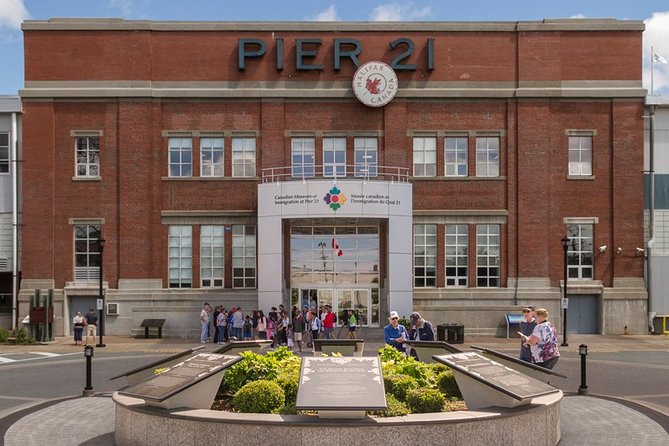
The tour begins at Pier 22, at 1041 Marginal Road, or with pickup from a listed downtown hotel. The port location is useful for cruise passengers and for anyone arriving by car. All-day parking is available there for $10 CAD, according to the tour information.
Pier 21 was the main entry point for many immigrants arriving in Canada. Paul explains its role as the Gateway to Canada, giving you a useful starting point for understanding Halifax as a place shaped by arrivals, departures, and ocean travel.
The Halifax Seaport Farmers’ Market is another early stop. It began by Royal Proclamation in 1750, just one year after Halifax was founded. The market has moved around the city over the centuries and now operates at the Seaport, with more than 250 vendors.
The market’s long operation is interesting, but you should not assume this tour gives you a long shopping break. It is part of a broad sightseeing route, so the emphasis is on the story and setting rather than a full market visit.
Nearby, an immigration sculpture recalls one family’s separation and reunion. Armando Barbon arrived from Italy in 1951, while his wife Yole and their two young children followed five months later. It is a simple, human counterpoint to the grander stories of ships and government buildings.
The waterfront also brings in Sir Samuel Cunard, the Halifax-born shipping magnate who founded the Cunard Line. The boardwalk, beside one of the world’s largest natural harbours, gives you a sense of why Halifax grew around the sea.
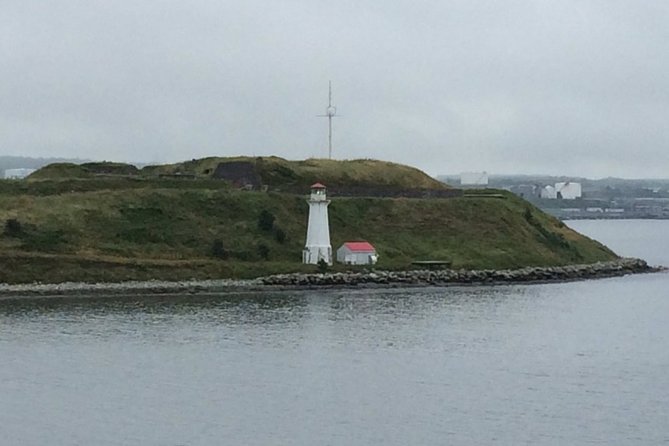
You’ll hear about Georges Island too. Its central harbour position made it part of Halifax’s British naval defences, and it later served as a holding area for Acadians during the deportations from 1755 to 1763. Fort Charlotte, old batteries, tunnels, and local stories give the island an air of mystery, even though you view it from the mainland rather than touring it on foot.
Breweries, ships, and maritime memory
Alexander Keith’s Nova Scotia Brewery connects local beer with Halifax’s commercial past. Keith opened the brewery nearly 200 years ago, and the site remains a popular destination for beer fans. This tour explains the founder and the brewery’s place in the city, but alcohol is not included.
HMCS Sackville adds a more serious naval note. It is the only surviving Allied corvette from the Second World War’s fleet of 269 and serves as Canada’s Naval Memorial. The ship is also a National Historic Site.
If you have time before or after the tour, the Maritime Museum of the Atlantic is a sensible companion visit. Its exhibits cover the age of sail, steam, wartime convoys, the Titanic, and the Halifax Explosion. The museum is not part of the six-hour route, so plan it separately.
The tour also touches on Maud Lewis, one of Nova Scotia’s best-known folk artists. This is a brief cultural thread within a day dominated by maritime and military stories, but it helps show that Halifax’s identity is not only about disasters and ships.
Historic buildings in the city center

The downtown portion moves through a dense collection of old buildings. Historic Properties contains three blocks of waterfront warehouses dating from the late 1700s and early 1800s. Their Victorian-Italianate façades are among the most recognizable old commercial buildings in Halifax.
St. George’s Round Church is quite different. Built in 1800 for the growing Little Dutch Church congregation, its cylindrical wooden design follows the Palladian style. Paul explains the church’s sad history, making this more than a quick architectural photograph.
St. Paul’s Church, founded in 1749, was the first Anglican cathedral built outside England and is Halifax’s oldest building. The Ghost Window and a piece of timber set into an interior wall are linked to the 1917 explosion.
The civic and political buildings keep the story moving:
- Halifax City Hall was built between 1887 and 1890 and is a National Historic Site.
- Province House opened in 1819 and is Canada’s oldest legislative building.
- Government House has served as the official residence of Nova Scotia’s lieutenant governor for more than 200 years.
- St. Mary’s Cathedral Basilica is noted for its Gothic Revival design.
- The Halifax Court House, completed in 1863 with a later east wing, uses Italian Renaissance design.
You generally see these sites from the vehicle or during short stops, rather than taking extended interior tours. That is important when setting expectations. The value comes from the number of landmarks Paul can explain in a limited time, while the cost is less time for independent exploration.
The route also includes the modern building known for its design resembling a stack of books. It was featured by CNN among the eye-catching new buildings of 2014, giving the old city center a contemporary visual pause.
Same province, a completely different day out:
- Halifax Harbour Hopper Tour
★ 4.5 · 1,296 reviews - Halifax Peggy’s Cove Express
★ 4.0 · 801 reviews - Wine and Lunch Escape
★ 5.0 · 562 reviews - Halifax Small-Group Express Peggy’s Cove Tour
★ 4.5 · 544 reviews
The Citadel and Halifax’s military clock

The schedule aims to reach Halifax Citadel National Historic Site at noon. The noon gun has been fired as a Halifax tradition since 1856, and the changing of the guard by the 78th Highlanders adds ceremony to the visit.
The present Citadel, also called Fort George, was completed in 1856. Its star-shaped design, defensive ditch, ramparts, and broad firing lines show how seriously Britain treated Halifax Harbour. No enemy force attacked the fort, but its position above downtown made its purpose clear.
The planned stop is about 15 minutes, and admission is not included. That is enough for the noon gun and a quick look, but not enough for a full Citadel visit. If you want the tunnels, exhibits, ramparts, and costumed interpretation, return later with a separate admission ticket.
The Old Town Clock is another short stop. Prince Edward, Duke of Kent, arranged for the turret clock in 1800 because the garrison had a reputation for tardiness. It is a small, amusing story that adds personality to the military history.
Churches, cemeteries, and Halifax’s human stories

The Old Burying Ground contains more than 1,200 headstones and footstones from the 18th and early 19th centuries. Its stone wall, iron fence, trees, and Crimean War monument make it a quiet green space in the middle of downtown.
The cemetery stops later in the day are more emotionally demanding. Fort Massey Cemetery contains the graves of British and Canadian soldiers, veterans, and spouses. Holy Cross Cemetery includes about 25,000 burials, many of them Irish, along with Sir John Sparrow Thompson, Canada’s fourth prime minister.
Inside Holy Cross is Our Lady of Sorrows Chapel. More than 1,800 people gathered to build it in one day in 1843, and its French stained glass dates from the 16th and 17th centuries.
All Saints Cathedral is connected to Halifax’s Titanic story through the first Titanic funeral held there for William Henry Harrison, Bruce Ismay’s private secretary. At Camp Hill Cemetery, you’ll hear about figures including folk artist Viola Desmond, Alexander Keith, Joseph Howe, Titanic survivor Hilda Mary Slayter, and Confederate naval officer John Taylor Wood.
These stops require a little sensitivity. The tour deals with death, displacement, war, and disaster in direct detail. For me, that is part of its value, but it is not light sightseeing. You’ll get more from the visit if you are comfortable with memorial sites and difficult stories.
Halifax Explosion and Titanic cemeteries
The Halifax Explosion section is the tour’s most powerful historical passage. On December 6, 1917, the munitions ship SS Mont Blanc exploded in the harbour. About 1,900 to 2,000 people died, around 9,000 were injured, and roughly 25,000 were left without homes.
At the Mont Blanc Anchor Site, you can see the 1,140-pound anchor shaft thrown about 2.3 miles by the blast. Another cannon was hurled nearly three miles to Albro Lake in Dartmouth. These physical objects make the scale of the explosion easier to grasp than numbers alone.
The Halifax Explosion Memorial Bell Tower sits on Fort Needham above the devastated area. Its bells honour those killed or injured, those who lost homes and family, and the people who rebuilt Halifax and Dartmouth. The original bells came from a church connected to Barbara Orr, who lost her entire family in the blast.
The Titanic story unfolds at Mount Olivet and Fairview Lawn cemeteries. Mount Olivet contains markers for 19 Roman Catholic Titanic victims, along with stories connected to Margaret Rice and other people buried there. Fairview Lawn is the best-known Titanic cemetery, with 121 victims interred there, including J. Dawson and Sidney Leslie Goodwin.
The route also includes Halifax Explosion graves at Fairview and the story of Vincent Coleman, remembered as a hero of the disaster. You’ll hear about the local impact rather than only the famous names. That makes the Titanic and explosion sections feel connected to Halifax families, churches, neighbourhoods, and cemeteries.
Parks, universities, and views beyond downtown
Point Pleasant Park covers 75 hectares at the southern end of the Halifax peninsula. Its trails pass coastal areas and old fortification ruins, and Halifax rents the land from the British government for one shilling per year under a 999-year lease.
The tour also passes Dalhousie University, founded in 1818, and the University of King’s College, established in 1789. King’s is Canada’s oldest chartered university and the first English-speaking university in the Commonwealth outside the United Kingdom.
In Halifax’s west end, Sir Sandford Fleming Park, known as The Dingle, provides a change of pace. Sir Sandford Fleming donated the park in 1908, and the Dingle Tower was dedicated in 1912 to mark 150 years of representative government. The stop is about 10 minutes, so expect a view and explanation rather than a long park walk.
The Halifax Public Gardens allow more time, about 30 minutes. This 17-acre Victorian garden has ornamental gates, a wrought-iron fence, statues, fountains, trees, shrubs, and seasonal plant displays. It was designated a National Historic Site in 1984.
The garden stop is one of the best chances to stretch your legs. Still, 30 minutes is a quick visit for anyone who enjoys plants or photography. If you want slow paths and careful photographs, plan a return visit.
Dartmouth, lunch, and Fisherman’s Cove
Crossing to Dartmouth changes the feel of the day. Lake Banook is associated with canoeing, kayaking, rowing, and dragon boat clubs, and it has a claim to being the birthplace of ice hockey.
Lunch is planned at Evan’s Seafood, with food orders called ahead to speed things up. You can choose fresh Nova Scotia seafood, including a gluten-free option, while enjoying a view of Halifax. Lunch is not included, so budget separately for your meal and any drink.
The lunch stop lasts about 30 minutes. That works well for a quick meal, but it is not a long restaurant break. If you have dietary needs, the stated gluten-free option is useful, though you should still confirm your order directly.
Fisherman’s Cove closes the route on a more colourful note. This restored 200-year-old working fishing village has small buildings, harbour views, and plenty of photo opportunities. The 30-minute stop gives you time to walk around briefly, take pictures, and enjoy a contrast to the formal downtown landmarks.
Comfort, timing, and practical value
The tour costs $131.43 per person and lasts about six hours. You receive transport in an air-conditioned Ford Transit 350 XLT high-roof van, bottled water, and WiFi. The van’s higher roof makes getting in and out easier, a useful detail if you have limited mobility.
The tour requires at least four people and accepts no more than 10. Seating goes to the earliest confirmed choices, so book early if you care about where you sit. The tour is offered in English, with mobile tickets and pickup from listed downtown hotels or the port meeting point.
I see the price as fair if you want a wide survey of Halifax without arranging several taxis or researching distant sites yourself. You are paying for transport, a small group, a full route, and Paul’s detailed narration. The value is weaker if you only want the waterfront, Public Gardens, and Citadel, since you can explore those central places independently.
Book at least 24 hours ahead for a full refund if plans change. Poor weather or failure to reach the minimum group size can lead to a different date or a full refund. Service animals are allowed, and most people can participate, but the experience still involves getting in and out of the van and taking several short walks.
Cruise timing deserves special attention. The standard experience runs in the morning, with operating hours listed from 8:00 to 11:30 for departures. If your ship leaves early, tell the operator your required return time before booking. A short port call may mean missing Dartmouth, Fisherman’s Cove, or the explosion memorial, and returning from downtown to the ship can involve a walk of roughly 1.8 kilometres if you are dropped near the waterfront rather than directly at the vessel.
Who should book this Halifax tour?
Book it if you want history first, especially Titanic, the Halifax Explosion, military Halifax, immigration, cemeteries, and local personalities. It is also a strong choice if you have only one day and want to see both Halifax and Dartmouth without handling the driving.
The tour suits you if walking long distances is difficult. It is primarily vehicle-based, with short stops at the Public Gardens, cemeteries, the Citadel, Fisherman’s Cove, and memorials. It also suits families and couples who prefer a small group to a large bus.
Skip it if you want a relaxed market morning, a full Citadel visit, a museum afternoon, or plenty of time for photographs. Six hours covers a lot, but it does so by keeping the route moving.
FAQ
How long does the Half-Day Historical Tour of Halifax last?
The experience lasts approximately six hours, including time in Halifax, Dartmouth, and Fisherman’s Cove.
Where does the tour begin?
The listed meeting point is Pier 22 at 1041 Marginal Road in Halifax. Pickup is also offered from listed downtown hotels.
How many people can join the tour?
The tour requires a minimum of four people and has a maximum of 10 travelers.
Is lunch included in the price?
No. Lunch at Evan’s Seafood is optional and must be paid for separately. Alcoholic beverages are also not included.
Is admission to Halifax Citadel included?
No. Admission to Halifax Citadel National Historic Site is not included. The tour aims to reach the site for the noon gun and changing of the guard.
What happens if I need to cancel?
You can receive a full refund if you cancel at least 24 hours before the start time. Cancellations or changes made within 24 hours are not refunded, except when the operator cancels because of poor weather or an insufficient number of people.
Should you book it?
If you want Halifax explained rather than simply photographed, I would book this tour. Paul McNeil’s detailed presentation, the small van, and the unusual mix of Titanic cemeteries, explosion memorials, old churches, Dartmouth, and Fisherman’s Cove give you a strong sense of how the city was shaped.
Just go in expecting a packed, vehicle-heavy day. Confirm your cruise return time, bring a little extra for lunch and Citadel admission, and save the Maritime Museum or a longer Citadel visit for another time. For a first look at Halifax with serious historical depth, this is a worthwhile choice.
Just added around Halifax
- Halifax: Peggy’s Cove, Lunenburg, and Annapolis Valley Tour★ 5.0 · 101 reviews
- Seaweed Tours Lunenburg N.S Can UNESCO world heritage site.★ 4.8 · 5 reviews
- Halifax: South Coast Nova Scotia Private Day Tour★ 4.6 · 10 reviews
- Peggy’s Cove, Lunenburg & 2 Hidden Gems – Full Day Tour★ 5.0 · 83 reviews
- From Halifax: Peggy’s Cove Bus Tour★ 4.6 · 34 reviews
- Lunenburg: Zodiac Wildlife Tour with Naturalist Guide★ 5.0 · 5 reviews
- Halifax: Peggy’s Cove, Citadel and Titanic Cemetery Tour★ 4.0 · 180 reviews
- Halifax: Hop-on Hop-Off Double Decker Bus City Tour★ 4.2 · 85 reviews
Historical Tours, compared.




Evening Gourmet Tour 5 Course Dinner – History and Food in Old Quebec City
Read our review →


Browse the lists this tour appears in