
Reviewed · HISTORICAL TOURS
Sports, Street Skateboarding, Economics, History & Culture
Toronto’s downtown story gets a fresh twist on this 90-minute walking tour with local skateboarder Duncan. Instead of moving from one famous building to the next, you’ll connect the city’s film industry, underground PATH system, financial power, street-skating culture, and major-league sports. The result is a tour about how Toronto works, not just how it looks.
I like two things right away: the route links subjects that rarely appear together, and Duncan adds personal stories about growing up in Toronto and skating its streets. I also like the practical finish, with a Google Map of his picks for food, drinks, and dessert. The main drawback is that this is a fast urban walk, and some stops make more sense to people who enjoy city planning, business, film, or sports than to those seeking classic sightseeing.
In This Review
- Key points at a glance
- Nathan Phillips Square: Toronto in one public room
- Bay Street and the real-life story behind Suits
- Walking under downtown in the PATH
- The Financial District and Toronto’s economic engine
- Street skateboarding on Toronto’s hard surfaces
- Brookfield Place and the NHL Situation Room
- Legends Row and Toronto’s sports identity
- What the price includes, and what it does not
- Who will get the most from this walk
- Practical details before you book
- Should you book Duncan’s Toronto walk?
- FAQ
- How long does the Toronto walking tour last?
- Where does the tour begin?
- Where does the tour end?
- What language is the tour offered in?
- Is the ticket mobile?
- How large can the group be?
- Is food included in the tour price?
- Can I cancel for a full refund?
Key points at a glance
- Nathan Phillips Square sets the stage: Learn how Toronto’s best-known civic space changed over time, hosted a major Canadian event, and became home to the famous Toronto Sign.
- The Bay Street film connection is unusually specific: See the lobby location associated with Suits and learn about Meghan Markle’s time filming there, along with Toronto’s wider film industry.
- The PATH is treated as a living system: The walk covers its history, wayfinding tools, pandemic closure, and the effect of hybrid work on underground businesses.
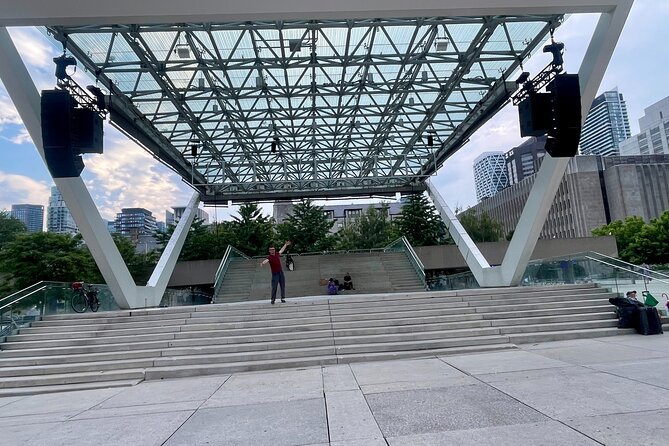
- Skateboarding gives the tour its personal edge: Duncan explains how downtown architecture helped launch professional careers and why street skating remains complicated in Toronto.
- Brookfield Place links architecture with hockey: The stop includes the building’s design and the NHL Situation Room in its southwest tower.
- The finish is sports-heavy: Legends Row, the Maple Leafs, the Raptors, Kawhi Leonard’s 2019 championship run, and the rename of Bremner Street to Raptors Way all come into play.
Nathan Phillips Square: Toronto in one public room
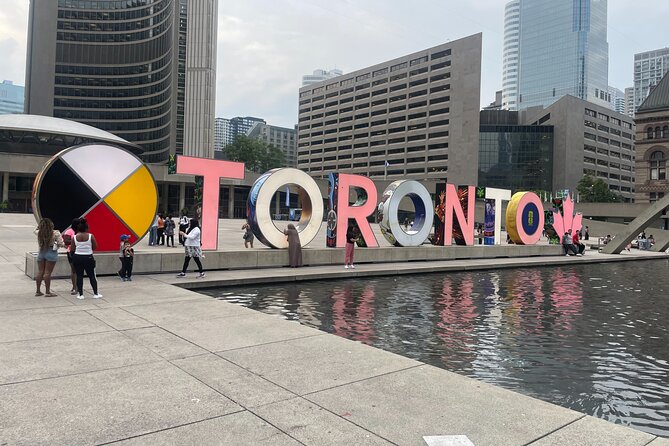
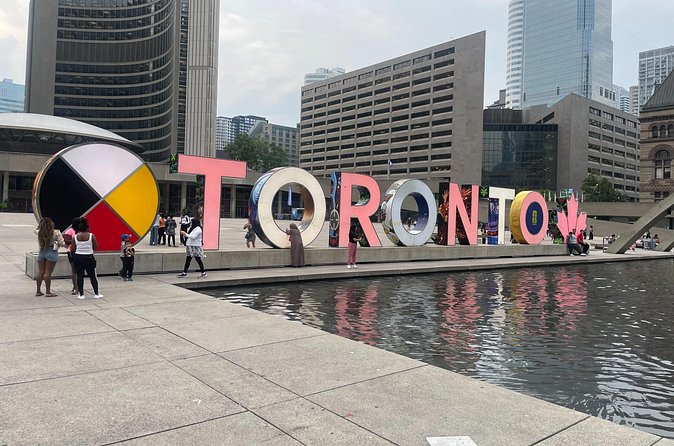
The tour begins at 100 Queen Street West, beside Nathan Phillips Square. This is a smart starting point because the square gathers several versions of Toronto in one place: civic government, public art, winter recreation, major events, and everyday city life.
You’ll hear how the square developed and how it hosted what is described as the largest event in Canadian history. The Toronto Sign, positioned by the ice rink, gives you an easy photo stop, but the point here is not simply to take a picture and move on. Duncan uses the site to explain how Toronto presents itself to residents, visitors, and the wider country.
I would pay attention to the newer Reconciliation Garden beside the square. One particularly useful part of Duncan’s approach is that he connects visible public spaces with the stories and ideas behind them. That makes the opening more than a standard introduction to City Hall.
This stop also helps you get your bearings. From here, the walk shifts toward the business core, where grand civic space gives way to office towers, pedestrian routes, film locations, and street architecture.
A few more Toronto trips to weigh up
- Toronto: Dark History Nighttime Walking Tour
★ 4.7 · 273 reviews - Toronto: Distillery District Historic Walking Tour
★ 4.8 · 267 reviews - Toronto Local Beer Tour: 2 Beers at 2 Unique & Historical Pubs
★ 5.0 · 154 reviews
Bay Street and the real-life story behind Suits
The Bay Street Corridor brings a pop-culture angle into the walk. You’ll see the lobby location linked with the television series Suits, where Meghan Markle played a paralegal before her marriage to Prince Harry. Duncan covers the attention she received from press and fans while filming, as well as the safety issues that can arise when a busy Toronto location becomes part of a popular show.
The value here is the connection between screen Toronto and working Toronto. You are not only hearing that a production used the city as a backdrop. You are also learning about the practical problems of filming around office workers, pedestrians, media attention, and security.
The stop lasts about 10 minutes and admission is free. Duncan also discusses other productions filmed in the area and the present challenges facing Toronto’s film industry. That wider context matters because Toronto often plays other cities on screen, while its own film economy must still compete for productions, locations, workers, and investment.
If you know Suits, this may be one of the most memorable stops. If you have never seen the show, the location still works as an example of how familiar city spaces can take on a second life through television.
Walking under downtown in the PATH
Part of the route passes through the PATH, Toronto’s large underground pedestrian network. This is one of the tour’s most useful sections because the PATH can feel confusing even when you have a map. Duncan explains how it developed, how its signs and wayfinding technology help people move through it, and how its businesses were affected when the network closed during the pandemic.
The PATH is not just a tunnel between office towers. It supports shops, services, food outlets, and daily movement through the core. Its fortunes depend heavily on people coming into downtown, so the shift toward hybrid work changed the rhythm of the area.
That makes this portion especially relevant if you want to understand present-day Toronto. You’ll hear how businesses have adjusted to lower weekday foot traffic and how underground retail depends on office workers, commuters, event crowds, and nearby residents.
I would not expect a long architectural tour of every PATH section. The experience covers only part of the network during a broader route. Still, Duncan’s focus on navigation and economic change gives you a reason to look at the signs, junctions, and storefronts instead of treating the PATH as a shortcut.
The Financial District and Toronto’s economic engine
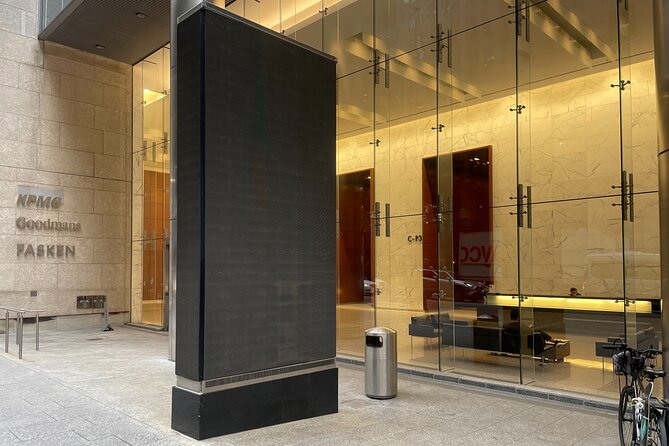
The Financial District section explains why this small part of downtown matters to the Canadian economy. You’ll learn about its development and the number of people employed there, placing the towers and office streets in a national context.
This is a good reminder that Toronto’s identity is not limited to the CN Tower or sports teams. The district is a workplace for a large number of people and a major center for Canadian business. Duncan’s stories help connect the buildings to the human activity inside them.
The tour also includes details that reward careful looking. One example from the route is the law society building and its fence, which Duncan uses to point out a feature many people would pass without a second thought. Another is the 2020 statue of a mesmerizing head, an unusual piece of public art that adds a more curious note to the business district.
I like this mix of economics and odd visual details. The financial core can seem formal and repetitive at first glance. A good explanation shows you the small signs of personality, history, and debate hidden among the polished facades.
Same province, a completely different day out:
- Toronto: Niagara Falls Day Tour with Optional Boat Cruise
★ 4.6 · 3,178 reviews - Niagara Falls Day Tour from Toronto
★ 5.0 · 2,889 reviews - Toronto: Casa Loma Entry Ticket
★ 4.7 · 2,705 reviews - Niagara Falls Canada Day Tour From Toronto + Boat Cruise Option
★ 5.0 · 2,576 reviews
Street skateboarding on Toronto’s hard surfaces
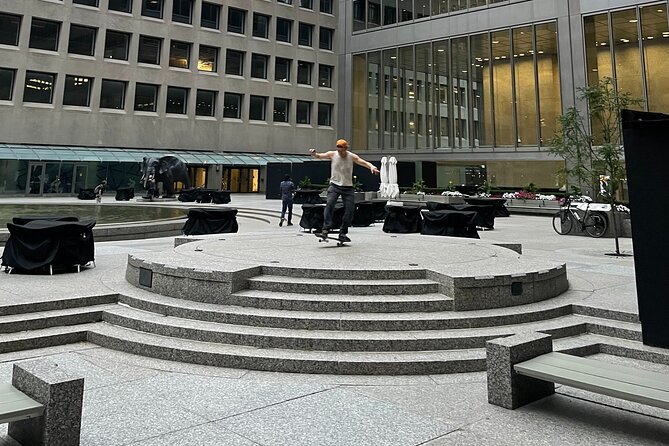
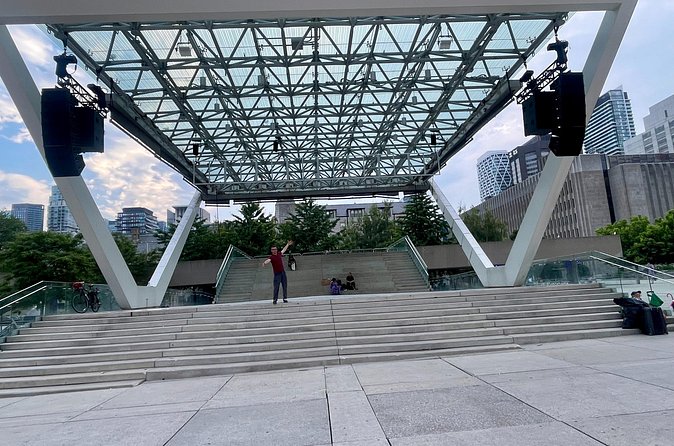
Street skateboarding is the tour’s most distinctive subject. Duncan is a local skateboarder, and he explains how the sport developed downtown, how professional skaters began filming tricks on Toronto’s urban architecture, and how some built careers from those early street sessions.
This gives you a different way to read the city. Steps, ledges, rails, plazas, and smooth stone surfaces can be useful public infrastructure, design features, or skate spots, depending on who is looking. The tour shows how skateboarders have used downtown architecture creatively, while also addressing the current climate for street skating in the core.
I appreciate that this is not presented as a simple celebration. Street skating can bring energy and skill to public spaces, but it can also conflict with property rules, pedestrian use, and security concerns. The tour looks at that tension rather than pretending the city and skaters always want the same thing.
You do not need to be a skateboarder to enjoy this section. It works because it shows how a subculture reads Toronto differently from a businessperson, film crew, sports fan, or first-time sightseer. For anyone interested in street photography, urban design, or youth culture, this may be the part that gives the tour its strongest identity.
Brookfield Place and the NHL Situation Room
Brookfield Place is a major architectural stop, with about 20 minutes devoted to its history and design. Duncan explains the building’s development and the features that make it more than another office complex.
The sports connection comes through the NHL Situation Room, located in the southwest tower. This is where the National Hockey League reviews game situations and handles important decisions. You will not be entering a private control center, but learning that such a key league operation is based here adds an unexpected layer to the building.
Brookfield Place also fits the tour’s larger theme. Toronto’s downtown is a working place, a film set, a sports center, and a public stage at the same time. The architecture reflects that mix, and Duncan keeps shifting your attention between the physical building and the institutions connected to it.
For me, this is a strong stop for first-time visitors because it gives context to a building many people might otherwise photograph without understanding. It is also useful for sports fans who want more than a visit to an arena.
Legends Row and Toronto’s sports identity
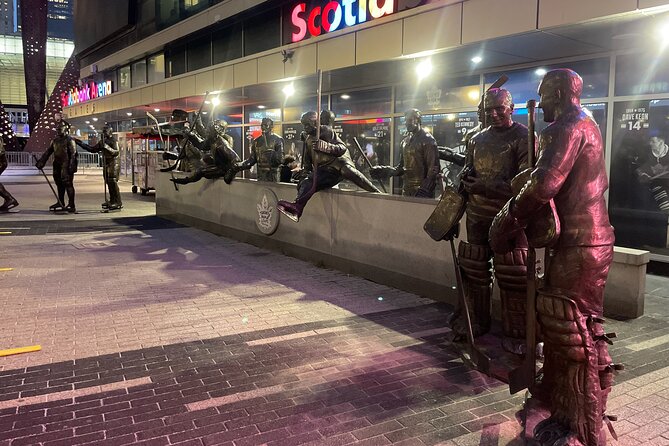
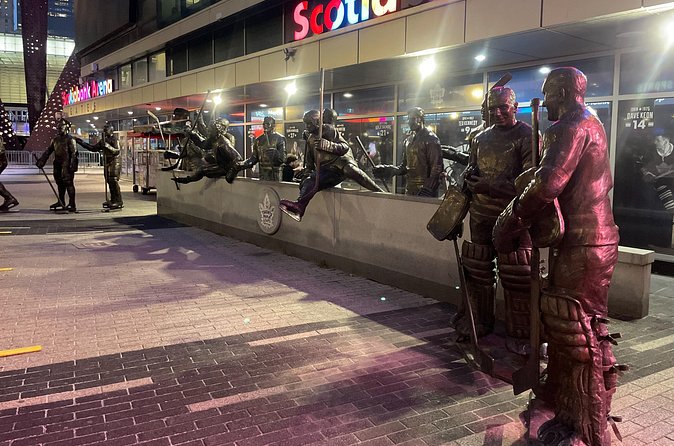
The route ends outside Scotiabank Arena at Legends Row on Raptors Way. The sculpture honors former Toronto Maple Leafs players, and Duncan explains its history and the artist who created it.
This final section then turns to the Toronto Raptors. You’ll hear about the team’s acquisition of NBA star Kawhi Leonard, the Raptors’ 2019 NBA Finals win, and the renaming of Bremner Street to Raptors Way. Duncan also addresses the problem the Raptors face as the only Canadian team in the NBA when trying to attract and sign top talent.
That last point adds useful realism. The Raptors’ championship season was a huge moment for Toronto, but building a lasting team brings practical challenges. Geography, player preferences, contracts, and the team’s position as Canada’s only NBA franchise all affect recruitment.
Ending here makes sense. You finish with public art, hockey memory, basketball success, and the city’s habit of attaching civic pride to its sports teams. The precise endpoint is at Legends Row outside Scotiabank Arena, near 19 The PATH at Maple Leaf Square.
What the price includes, and what it does not
At the listed price of $11.22 per person, this is inexpensive for a guided downtown walk lasting about an hour and a half. I see the value in the amount of ground it covers and in the range of subjects: public space, television, finance, underground transport, architecture, skateboarding, hockey, and basketball.
The included Google Map of Duncan’s Toronto recommendations adds real practical value. It covers food, drinks, and dessert, so you can use the tour as a starting point for the rest of your day. The offer of Toronto travel advice at the end is also useful if you are still planning meals or activities.
Tips are not included. You should also remember that this is an outdoor walking experience, even though part of it takes place in the PATH. Good shoes and weather-ready clothing are sensible choices.
The small maximum of 25 people helps keep the format manageable, though the experience may feel different with a full group than with a handful of participants. Since the tour depends on good weather, poor conditions can lead to a new date or a full refund.
Who will get the most from this walk
I would recommend this tour to you if you enjoy seeing a city through local stories rather than a list of famous landmarks. It suits first-time visitors who want a downtown orientation, but it also suits Toronto residents who have walked these streets for years without knowing the stories behind them.
It is particularly well matched to:
- People interested in urban history and public art
- Fans of Suits, Toronto film locations, or the city’s production industry
- Sports fans curious about the NHL Situation Room, Maple Leafs history, and the Raptors
- Skateboarders and anyone interested in street culture
- Visitors who want to understand the PATH and Financial District
- Locals looking for new places and a fresh reading of familiar streets
The tour may be less suitable if you want a slow photo walk, a major museum visit, or a detailed architectural lecture at every building. It moves across several subjects, so you need to enjoy variety and conversation.
Duncan’s speaking style is another reason to consider it. His approach is friendly, easy to follow, and open to questions. Personal memories from growing up in Toronto give the information a local voice, while his skateboarding background explains why the route pays attention to details most guides might skip.
Practical details before you book
The meeting point is 100 Queen Street West in Toronto. The walk ends at Legends Row on Raptors Way outside Scotiabank Arena, with the listed address at 19 The PATH, Maple Leaf Square.
The tour is offered in English and includes a mobile ticket. It is near public transportation, service animals are allowed, and most people can participate. Confirmation is sent at booking, and the maximum group size is 25.
You can cancel for a full refund up to 24 hours before the start time. Changes or cancellations inside that 24-hour window are not accepted for a refund. If bad weather forces cancellation, you will be offered another date or a full refund. The same applies if the minimum number of participants is not reached.
I would book with the weather in mind and leave room in your schedule after the finish. The tour ends near Scotiabank Arena and the PATH, so you can continue exploring downtown, eat nearby, or use Duncan’s food map for your next stop.
Should you book Duncan’s Toronto walk?
Book it if you want a low-cost, local-led introduction to downtown Toronto with subjects that go well beyond standard sightseeing. The strongest reasons are Duncan’s personal connection to street skateboarding, the unusual blend of film and finance, the practical PATH discussion, and the food map you receive at the end.
I would especially choose it for a first or second day in Toronto, when you still have time to use the guide’s recommendations. Locals can also benefit, since the route includes public art, building details, and stories that are easy to miss on familiar streets.
Skip it if you want an indoor attraction, a narrow focus on one subject, or a relaxed pace with long stops. For everyone else, $11.22 buys a thoughtful walk through the city’s civic center, business core, underground routes, sports culture, and street life.
FAQ
How long does the Toronto walking tour last?
The tour lasts approximately 1 hour and 30 minutes.
Where does the tour begin?
It begins at 100 Queen Street West, Toronto, Ontario, M5H 2N2, Canada.
Where does the tour end?
The walk ends at Legends Row on Raptors Way outside Scotiabank Arena. The listed endpoint is 19 The PATH at Maple Leaf Square.
What language is the tour offered in?
The tour is offered in English.
Is the ticket mobile?
Yes. A mobile ticket is provided.
How large can the group be?
The experience has a maximum of 25 participants.
Is food included in the tour price?
No food or drinks are included. You do receive a Google Map with Duncan’s recommendations for food, drinks, and dessert.
Can I cancel for a full refund?
Yes. You can cancel at least 24 hours before the scheduled start time for a full refund. Poor weather or failure to meet the minimum number of participants may also lead to a different date or a full refund.
Just added around Toronto
- Toronto Craft Brewery Tour★ 5.0 · 97 reviews
- Canada eSIM | 3-30 days | Daily data | QR code★ 4.0 · 12 reviews
- Underground Toronto PATH Tour★ 4.5 · 6 reviews
- Handcrafted Donuts of Toronto: A Sweet City Walking Tour★ 5.0 · 141 reviews
- Customizable Walking Tour of Toronto’s Hidden Gems★ 5.0 · 15 reviews
- Pottery wheel class in Toronto Bay&Dundas★ 4.5 · 5 reviews
- Toronto’s Longest Running Improv Theatre – Marquee Show★ 5.0 · 5 reviews
- Toronto Airport Private Transfer to Downtown★ 4.5 · 10 reviews
Historical Tours, compared.



Evening Gourmet Tour 5 Course Dinner – History and Food in Old Quebec City
Read our review →
Browse the lists this tour appears in