
Reviewed · WALKING & GHOST TOURS
Ancient Trees of Vancouver Walking Tour
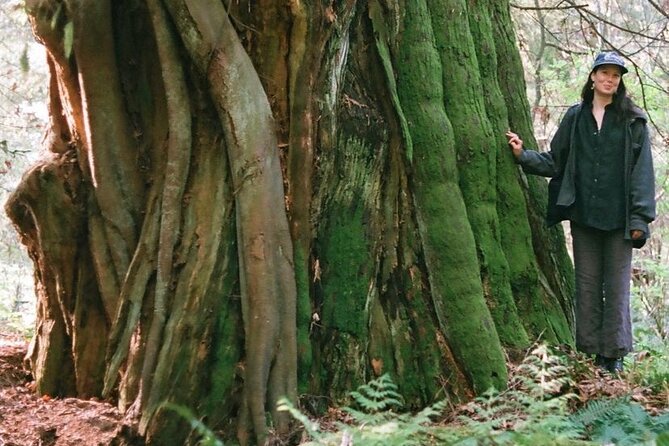
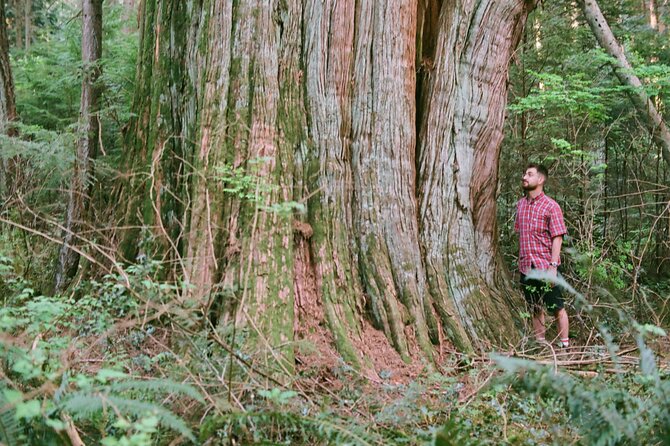
Stanley Park hides trees far older than Vancouver itself. On this three-hour walk, you follow forest trails to ancient western red cedars, towering Douglas firs, and one maple described as the largest known in Canada. Some cedars are estimated at 1,000 years old, which makes this feel less like a city park outing and more like a meeting with living history.
I like Colin Spratt’s focused expertise and the way he connects tree science with Vancouver’s past and the Coast Salish people who lived here for thousands of years. I also like the small cap of 10 people, plus the old maps, postcards, and photographs that give the forest a human timeline.
The main consideration is the price: at $56.33 per person, this is not a casual free walk through Stanley Park. You are paying for three hours of specialist guiding, and the experience works best if you are genuinely curious about forests, conservation, and the stories held by old trees.
In This Review
- Key points to know before you book
- Meeting ancient trees at Ferguson Point
- What makes Stanley Park’s old growth special
- Colin Spratt’s blend of science, stories, and local history
- Cedar as the tree of life
- A walk that reveals what ordinary sightseeing misses
- How the three hours are likely to feel
- Who will get the most from this experience
- Practical details that affect your decision
- My call: book it if trees are part of your travel story
- FAQ
- Where does the Ancient Trees of Vancouver Walking Tour begin?
- Where does the tour end?
- How long does the walking tour last?
- How much does the tour cost?
- How many people can join the tour?
- Is the tour offered in English?
- Are morning and afternoon departures available?
- What is included in the experience?
Key points to know before you book
- Ancient trees inside an urban park: See old-growth western red cedars and Douglas firs in Stanley Park, including trees described as roughly 600 to 1,000 years old.
- Colin Spratt leads the walk: Your guide is a big-tree expert and member of the BC Big Tree Committee.
- Old photographs bring the forest to life: Maps, 120-year-old postcards, and archival photographs help explain how the park and city changed.
- A small group keeps the walk personal: The maximum is 10 participants, a useful advantage on narrow forest trails.
- Three hours gives the subject room to breathe: Morning and afternoon departures make it easier to fit into a Vancouver sightseeing day.
- The focus goes beyond tree spotting: Expect ecology, conservation, Indigenous uses of cedar, logging, and the history of Stanley Park.
Meeting ancient trees at Ferguson Point
The walk begins at Ferguson Point, at 7501 Stanley Park Drive. It ends back at the same meeting point, so you do not need to arrange a separate ride from the finish.
That simple out-and-back setup matters in a park as large as Stanley Park. You can plan the rest of your day around one known location rather than guessing where a forest walk will leave you. Pickup and drop-off are not included, so you need to make your own way to Ferguson Point.
The tour lasts about three hours. That is long enough to explore several parts of the forest without turning the outing into a full-day commitment. Morning and afternoon options give you room to place it before or after other Vancouver plans.
You will be walking on park trails, and the activity information says most people can participate. Still, three hours on foot calls for sensible shoes and clothing suited to the day. The tour is a walking experience, not a drive-by tree viewing.
More Walking & Ghost Tours in Vancouver
- Vancouver Lost Souls of Gastown Walking Tour
★ 5.0 · 1,273 reviews - A Wok Around Chinatown: Culinary and Cultural Walking Tour Led by a Chef
★ 5.0 · 610 reviews - The Forbidden Downtown and Gastown Walking Tour
★ 5.0 · 476 reviews
What makes Stanley Park’s old growth special
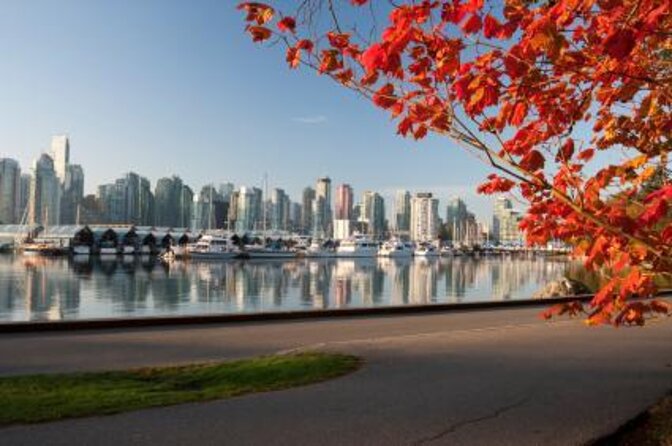
Stanley Park is famous for its seawall and city views, but the forest is the real reason to slow down here. The walk takes you toward the park’s remaining old-growth trees, where age changes the scale of everything around you.
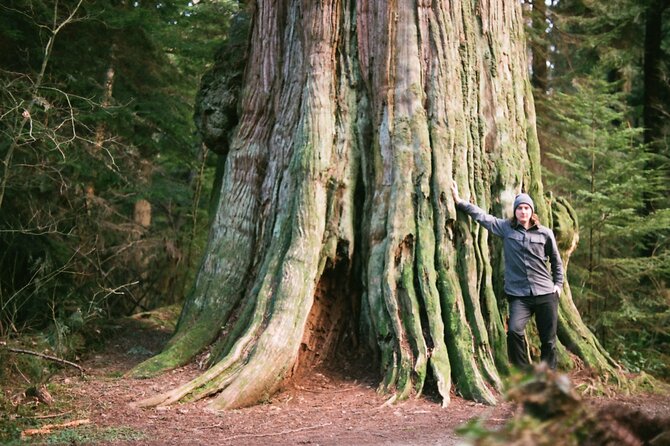
The Douglas firs can reach heights that make ordinary city trees seem small. The cedars are the real time travelers, with examples described as 1,000 years old. You may also see the broad, impressive maple identified as the largest known maple tree in Canada.
A useful part of this experience is learning that old trees are not simply large versions of young ones. Their shape, damaged sections, hollow trunks, and unusual crowns all tell a story about age and survival. One review describes ancient cedars with candelabra-like tops, a form associated with very old trees.
You may also see how several generations of forest life occupy the same space. Fallen trunks can become nurse logs, supporting moss, seedlings, and new trees as they decay. That idea changes the way you look at what first appears to be dead wood. In this forest, decay is part of renewal.
The walk also deals with the less romantic side of old growth. Ancient forests face pressure, and the guide explains their ecological importance and the threats they face today. You come away with more than a list of remarkable tree sizes. You gain a clearer sense of why mature forests matter and why they cannot be replaced quickly.
Colin Spratt’s blend of science, stories, and local history
Colin Spratt is the named guide, a well-known big-tree seeker and member of the BC Big Tree Committee. His role is central to the experience. This is not a standard park orientation with a few tree names added along the way.
The strongest praise centers on Colin’s passion, clear explanations, patience, and ability to make complicated subjects easy to follow. He ties tree age and forest ecology to Vancouver’s development, Stanley Park’s past, logging, and conservation.
That range gives the walk a good rhythm. One moment you are considering how a tree’s age is estimated. The next, you are looking at an old image of the area and thinking about how much has changed. The old maps, postcards, and photographs are especially useful because they let you compare the forest and city across time.
Colin also uses personal anecdotes, local legends, and philosophical ideas about nature, according to the tour material. That combination suits people who do not want a lecture. You get facts, but you also get reasons to care about them.
Families can find plenty to discuss here. Children have asked about tree age, hollowness, seedlings, and forest cycles, and Colin is described as patient with kids from ages 7 to 11. The activity is educational, but it does not need to feel like school if your family enjoys asking questions.
Cedar as the tree of life
The western red cedar receives special attention, and rightly so. The tour explains how Coast Salish communities used cedar in daily life, including for longhouses, canoes, clothing, and rope.
That context adds respect and depth to the walk. You are not simply looking at a giant trunk as a natural oddity. You are learning how one tree supported practical, cultural, and community life for Indigenous people who have called this area home for thousands of years.
The experience also covers traditional knowledge connected with working cedar. One example describes how Indigenous people tested trees with antlers before carving canoes. Details like this help you understand that selecting a tree required close attention to its qualities, not just a desire for the biggest trunk.
You may also learn why old cedars can be hollow and how hollow trees can still remain alive. The forest’s dead material has a purpose too. One explanation presented on the walk is that much of a tree is no longer living tissue, yet that material protects the living parts and supports fresh growth.
This is an important correction to the usual idea that a hollow or decaying tree is failing. In an old forest, a damaged trunk can shelter animals, hold moisture, and feed the next generation. The tour makes those processes visible.
Same province, a completely different day out:
- Vancouver Half-Day Whale Watching Adventure with Free Photos
★ 5.0 · 5,000 reviews - Big Bus Vancouver Hop-On Hop-Off Sightseeing Tour
★ 3.5 · 3,028 reviews - Victoria & Butchart Gardens Tour with Ferry from Vancouver
★ 4.5 · 2,703 reviews - Vancouver: Covered Whale Watching Adventure with Free Photos
★ 4.8 · 2,260 reviews
A walk that reveals what ordinary sightseeing misses
You can visit Stanley Park for free and see plenty of trees without booking anything. That is the fair comparison when considering $56.33.
The value here lies in what you would likely miss on your own. The tour takes you to notable old trees and explains why they matter. It also shows you how to read clues such as tree form, hollow trunks, fallen logs, and the relationship between young growth and older trees.
The old maps and 120-year-old postcards add another layer that a normal stroll does not provide. They connect the forest to the changing city and help explain how these remaining trees survived beside an urban center.
The maximum group size of 10 is another part of the value. A large group can make a forest walk feel like a queue, especially when everyone needs to gather around a tree or hear a story. With fewer people, you have a better chance to ask questions and keep pace with the guide.
That said, the price may feel high if you mainly want fresh air and a simple park walk. You can explore Stanley Park without a guide, and the tour will not appeal as much if tree ecology or local history is not your thing. The cost makes sense for a specialist experience, not for basic access to the park.
How the three hours are likely to feel
The walk is designed around one main location, Stanley Park, rather than a string of city stops. That keeps the subject focused and avoids wasting time on transfers.
The first part sets the scene: the park’s old growth, its place in Vancouver, and the Coast Salish communities connected to the area. From there, the focus moves to individual giant trees and the ecological systems around them.
Expect frequent pauses. A three-hour forest tour needs time to examine trunks, crowns, fallen wood, and evidence of regeneration. You are not simply marching from one landmark to the next.
The pace is described as an easy walk on park trails. Even so, I would not book it if you dislike spending several hours outdoors or stopping often for explanation. The point is careful observation, not covering a large distance.
Morning and afternoon departures are useful for trip planning. You can choose the cooler or more convenient part of your day, then pair the tour with other Stanley Park activities. The tour itself ends where it begins, which makes that planning easier.
Who will get the most from this experience
I would recommend this walk to people who enjoy nature but want more than scenery. It is especially suitable for anyone interested in tree identification, old-growth ecology, conservation, Vancouver history, and Indigenous uses of cedar.
It also works well for families with curious children. The ages 7 to 11 have been specifically noted as a good fit, and the guide’s patience with questions is a practical advantage. The three-hour length may still be a lot for children who are not interested in forests, so know your group.
Solo visitors and couples can benefit from the small group size. You do not need to organize a private tour to get a more personal format.
This may also suit repeat visitors to Vancouver. If you have already seen the seawall, totem poles, and main park viewpoints, this gives you a fresh reason to return. It shows a side of Stanley Park that is easy to miss when you stick to the most obvious routes.
I would be less likely to recommend it to someone seeking dramatic mountain views, fast sightseeing, or a highly active hike. The reward is attention and understanding, not speed or spectacle.
Practical details that affect your decision
The cost is $56.33 per person. Group discounts are available, though the details of those discounts are not provided. Since the park itself has no admission charge for this activity, the fee pays for Colin’s specialist guidance, the small group format, the prepared visual material, and access to a carefully chosen tree-focused route.
The activity is offered in English and uses a mobile ticket. Confirmation is provided at booking. Service animals are allowed, and most people can participate.
You must reach Ferguson Point on your own. There is no pickup or drop-off service at another Vancouver location. Make sure you allow enough time to arrive at 7501 Stanley Park Drive before the start.
The tour is often booked well ahead, about 46 days in advance on average. That is a useful planning clue, especially if your Vancouver dates are fixed. Morning and afternoon choices help, but a popular small-group activity can still fill before your trip.
Cancellation is flexible up to 24 hours before the start time for a full refund. Cancellations or changes made inside that 24-hour window are not accepted for a refund, and the cutoff uses local time.
My call: book it if trees are part of your travel story
I would book the Ancient Trees of Vancouver Walking Tour if I wanted a thoughtful, unusual morning or afternoon in Stanley Park. The combination of very old cedars, huge Douglas firs, Coast Salish knowledge, archival images, and conservation gives the walk more substance than a standard park stroll.
The strongest reason to go is Colin Spratt. His expertise and enthusiasm shape the whole experience, and the small group lets you benefit from that rather than simply listening from the back of a crowd.
I would skip it only if you want a free, unstructured walk or if three hours of tree-focused conversation sounds too narrow. For everyone else, $56.33 is a fair price for a specialist look at one of Vancouver’s most important natural places. Bring your curiosity, give the forest time, and you may leave seeing every old tree differently.
FAQ
Where does the Ancient Trees of Vancouver Walking Tour begin?
The tour begins at Ferguson Point, 7501 Stanley Park Drive, Vancouver, BC V6G 3E2, Canada.
Where does the tour end?
The activity ends back at the meeting point at Ferguson Point.
How long does the walking tour last?
The tour lasts approximately three hours.
How much does the tour cost?
The listed price is $56.33 per person. Group discounts are available.
How many people can join the tour?
The maximum group size is 10 participants.
Is the tour offered in English?
Yes. The tour is offered in English.
Are morning and afternoon departures available?
Yes. You can choose from morning and afternoon tour times.
What is included in the experience?
The tour includes a walking tour with an expert guide, ancient western red cedars, towering Douglas firs, archival maps, 120-year-old postcards, and photographs. Pickup and drop-off at the meeting point are not included.
More Walking Tours in Vancouver
- Gastown Historic Walking Food Tour
★ 5.0 · 1,863 reviews - Vancouver: Gastown Historical Walking Food Tour
★ 4.8 · 539 reviews - Gratuity-Based Vancouver City Highlights 3 Hour Walking Tour
★ 4.5 · 320 reviews - Vancouver Street Art and Craft Coffee 3 Hour Walking Tour
★ 5.0 · 47 reviews
Just added around Vancouver
- Vancouver: The Supernatural TV Show Locations Tour★ 4.9 · 32 reviews
- The Ultimate Stanley Park E-Bike Tour★ 4.9 · 33 reviews
- The Haunting of Vancouver Film Tour★ 4.9 · 9 reviews
- Sunset Bus Tour: Stanley Park & English Bay Photostops★ 4.5 · 181 reviews
- Stanley Park Self Guided Bike Tour★ 4.1 · 12 reviews
- Stanley Park EUC & E-scooters loop tour★ 5.0 · 4 reviews
- Stanley Park CarTour:SmallGroup/Comfort&CheaperThan BikeTour★ 4.9 · 46 reviews
- Snowshoeing At The Top Of The Sea To Sky Gondola★ 5.0 · 6 reviews
Walking & Ghost Tours, compared.
Old Quebec City: Grand Walking Tour with Private Option
Read our review →
The Original Old Montréal Walking Tour by Guidatour
Read our review →
Old Montreal Small-Group Walking Tour | Max 10 | by MTL Detours
Read our review →
Old Quebec Classique Walking Tour with Funicular
Read our review →
Old Quebec City Food Tour with 10+ Autentic Local Tastings
Read our review →

Browse the lists this tour appears in