
Reviewed · SELF-GUIDED TOURS
Old Town Quebec Secrets: Private Exploration Game and Tour
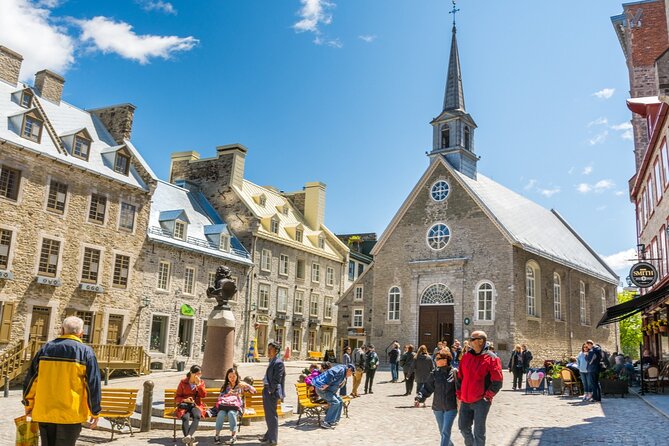
Old Quebec becomes a puzzle board in this self-guided walk, sending you from the Tourny Fountain and Saint-Louis Gate to Place Royale, the birthplace of French settlement in North America. You solve clues on your phone, then use each answer to reach the next stop.
I like the low price and the freedom to begin, pause, or continue when it suits you. I also like that the game works offline, since cobbled streets, stone walls, and phone data do not always make good partners. The walk mixes architecture, local stories, and light puzzle-solving instead of asking you to trail behind a guide.
The main catch is that this is an app game, not a guided tour. Some clues may be outdated or awkwardly worded, and one reported experience failed to work at all, so you should be comfortable troubleshooting on your own.
In This Review
- Key points to know before you go
- A puzzle walk through Old Quebec
- Starting at the Tourny Fountain
- Saint-Louis Gate and the limits of an old city
- The cannonball in the elm tree
- The Ursulines and Montcalm’s final resting place
- Holy Trinity Cathedral and Quebec’s British chapter
- Place de l’Hôtel-de-Ville and the changing public square
- The Séminaire de Québec and the roots of the colony
- Champlain’s monument and the beginnings of Quebec City
- Jean-Paul Lemieux and Quebec through art
- Place Royale, the cradle of French North America
- Parliament and the city hall
- Notre-Dame-de-Québec Basilica
- What the $9.29 price really buys you
- Practical advice for using the app
- The main weakness: clue accuracy
- Who should book this Quebec City game?
- Should you book Old Town Quebec Secrets?
- FAQ
- How long does Old Town Quebec Secrets take?
- How much does the experience cost?
- Is this a guided tour with a person?
- Does the game require mobile data or internet?
- Can I pause and resume the game?
- Where does the experience start and finish?
- Is the activity offered in French?
- What happens if my group has more than 15 people?
Key points to know before you go
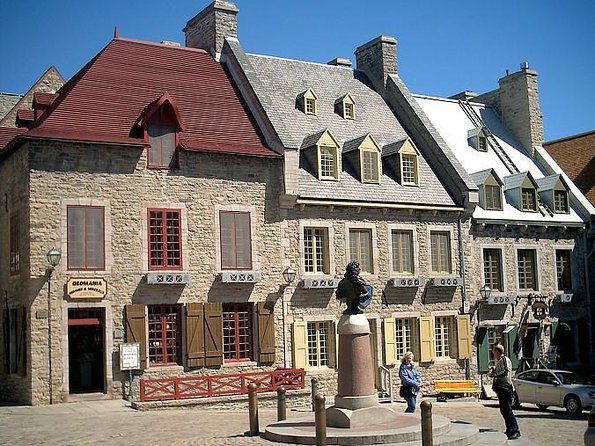
- Fourteen Old Quebec stops: The route links major landmarks with small curiosities, including a cannonball caught in an elm tree.
- Offline play: Download and prepare the game before setting out, then play without mobile data or internet.
- About 90 minutes: The stated duration suits a first look at the old city, though pauses and clue-solving can make it longer.
- Private and flexible: Only your group participates, and you can start, stop, and resume after booking.
- Excellent budget value: The cost is $9.29 per person, with group discounts and free play for kids.
- No human guide: The Questo app gives the directions and clues, so the experience depends on your phone and the accuracy of the game.
A puzzle walk through Old Quebec

This experience gives you a different way to read Quebec City. Instead of receiving a steady stream of facts from a guide, you inspect a fountain, gate, building, plaque, or statue and look for the answer that advances the game.
That small change matters. You are not simply passing a landmark while someone else explains it. You have to notice details around you. The challenge can be as simple as finding a date, identifying a name, or spotting a feature in the street scene.
The route covers some of Old Quebec’s most important sites. It also includes odd little details that are easy to miss on a standard sightseeing walk. The cannonball lodged in an elm tree is a good example. It is the sort of city mystery that catches your eye after the major monuments have begun to blend together.
The experience is listed at about one hour and thirty minutes. That is a useful target, not a strict schedule. A group that solves clues quickly may finish sooner. A family stopping for photos, snacks, or extra sightseeing will likely take longer.
A few more Quebec City trips to weigh up
- Old Quebec Scavenger Hunt and Highlights Self Guided Audio Tour
★ 4.0 · 8 reviews - Kayak/Paddleboard Rouge River – Self Guided Descent
★ 4.5 · 7 reviews - Quebec City Self-Guided Driving Audio Tour
★ 4.0 · 7 reviews
Starting at the Tourny Fountain
The game begins at 3004 Avenue Honoré-Mercier, then uses the app to guide you toward the first locations. One of the early stops is the Tourny Fountain, a grand work with an unexpectedly international past.
French sculptor Mathurin Moreau designed the fountain in 1853. Six copies were made, and the work appeared at the 1855 World’s Fair in Paris. The fountain gives the game a strong opening because it is attractive at first glance, then more interesting once you know where it came from.
Here, you look around for the answer to the challenge. That approach works well at a fountain because you can examine it at your own pace rather than trying to listen over traffic or a crowd.
I would give yourself a few minutes at each stop. The game is more enjoyable when you pause to look at the place itself, rather than treating every location as a quick checkpoint.
Saint-Louis Gate and the limits of an old city

The next stop brings you to Saint-Louis Gate, one of the entrances through Quebec City’s fortifications. The first gate at this location dates to the late 17th century, during the French Regime.
Under British rule, the army closed the gate at night. That policy restricted travel between the city and surrounding areas. It also disrupted trade and slowed the city’s growth.
This is a useful bit of context because gates are easy to admire only as handsome stone structures. The clue turns the gate into part of daily life. A doorway through the wall could decide who entered, who left, and when business could take place.
The game works best when you connect the clue to what you can see. Look at the gate as a working part of a fortified town, not just as a photo stop.
The cannonball in the elm tree
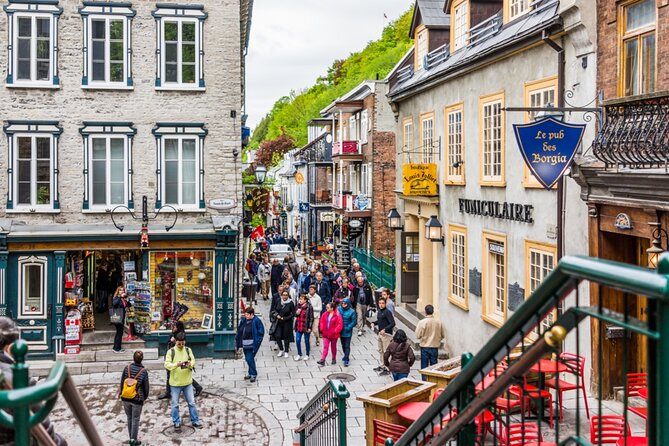
One of the route’s most unusual stops is an old elm on Rue Saint-Louis, at the corner of Rue du Corps-de-Garde. A large cannonball appears to be trapped in its twisted roots.
Calèche drivers have long pointed it out to passengers. Passers-by stop to study it and wonder how the cannonball got there. The story is memorable because it gives you something concrete to search for, and because it feels less polished than a formal monument.
This is the kind of stop I particularly like in a city game. You are not only moving between famous buildings. You are also looking down at roots, looking up at branches, and asking how a strange object became part of the street.
The drawback is that urban details can change. Construction, barriers, parked vehicles, or a new street arrangement may make a clue harder to solve. This is one reason to keep the app’s hint function in mind instead of insisting on a perfect score.
Same province, a completely different day out:
- Quebec City Walking Tour
★ 5.0 · 4,716 reviews - Quebec City: Guided Tour of Fairmont Le Château Frontenac
★ 4.7 · 3,027 reviews - Québec City: Guided Sightseeing River Cruise
★ 4.4 · 3,000 reviews - Half-Day Trip to Montmorency Falls and Ste-Anne-de-Beaupré from Quebec city
★ 4.0 · 2,718 reviews
The Ursulines and Montcalm’s final resting place
Founded in 1639, the Couvent des Ursulines is the oldest institution of learning for women in North America. Its chapel also holds the burial place of French general Louis-Joseph Montcalm, who died after the 1759 battle that determined the fate of New France.
The stop adds a personal and religious layer to the walk. You are moving from military gates and street curiosities into a place connected with education, faith, and the final days of a major figure in Quebec’s colonial history.
The game does not replace a visit inside the institution or chapel, but it gives you a reason to notice the site. If your group enjoys history, this is one of the stops where the short clue can lead to a much larger story.
Keep your expectations realistic. The experience provides a compact introduction, not an extended lecture or a full interior tour.
Holy Trinity Cathedral and Quebec’s British chapter

The Cathedral of the Holy Trinity was built in 1804 as the first Anglican church outside Britain. It is now a National Historic Site of Canada.
The building uses a neoclassical Palladian design modeled after St Martin-in-the-Fields in Trafalgar Square. That connection gives the church a clear place in the wider British world, while its location in Old Quebec shows how the city changed hands and cultures.
This is a strong contrast with the Ursulines and other French Catholic sites along the route. You get a quick view of Quebec City as a place shaped by both French and British institutions.
The clue-based format is useful here because it sends you looking at the building’s form. Notice the style, proportions, and setting before moving on. If you are interested in architecture, the stop gives you a reason to pay attention to design rather than only dates.
Place de l’Hôtel-de-Ville and the changing public square
The public square now known as Place de l’Hôtel-de-Ville has carried several names over time, including Grande Place, Grande Place de la Haute Ville, and Place du Marché. In 1900, it took its current name after city hall was built.
It was also known as Place Notre-Dame and Place de la Basilique into the middle of the 20th century. Those changing names show how public spaces can shift in purpose and identity as the city develops.
The location is near major religious and civic buildings, so it makes a natural puzzle stop. You can use the challenge to notice how the square relates to the surrounding streets, façades, and institutions.
This is also a good place to slow down if your group needs a break. Since the game can be paused, you do not have to solve the clue immediately or keep walking at the app’s pace.
The Séminaire de Québec and the roots of the colony

The Séminaire de Québec was founded in 1663 by François de Laval, who later became Quebec’s first bishop. The society trained priests, worked to evangelize Indigenous peoples, and administered the colony’s parishes.
The stop helps explain why Quebec City became an important religious and administrative center. The seminary was not simply a church-related school. It helped organize religious life across the colony and trained the people who would serve its parishes.
For you, the value is in seeing how one institution could shape education, religion, and government in early Quebec. The clue gives you a short task, but the building opens a wider window onto the city’s beginnings.
This part of the route suits anyone who likes institutional history. If your group prefers only scenery and quick photo stops, the information may feel more serious than the rest of the game.
Champlain’s monument and the beginnings of Quebec City
A monument honoring Quebec City’s founder was created by Paul Chevré and inaugurated in 1898. Its subject is Samuel de Champlain, whose role is central to the next major stop, Place Royale.
The monument gives you a chance to consider how cities choose to remember their founders. A statue is not the same thing as the original settlement, but it shows how later generations presented the city’s origins.
The app then leads you toward the lower part of Old Quebec. The route is not only a string of isolated landmarks. It gradually connects religious, military, civic, and commercial parts of the city.
Jean-Paul Lemieux and Quebec through art
Jean-Paul Lemieux was born in 1904 and died in 1990. He was one of Canada’s foremost 20th-century painters and worked in five different artistic periods.
This stop adds art to a route otherwise filled with churches, gates, government buildings, and colonial sites. You get a reminder that Quebec City is not only a place to study the past. It also shaped modern Canadian artistic life.
The information supplied for this stop does not identify a specific gallery or building connected with Lemieux, so you should follow the app carefully and use the clue as your guide. Do not assume the stop includes a museum admission or a formal art presentation.
Place Royale, the cradle of French North America
Place Royale is the historic heart of the walk. It is identified as the precise location where Samuel de Champlain built the first permanent French settlement in the Americas.
In 1608, Champlain’s first habitation served as a fort, store, trading post, and residence. One compact site handled defense, business, storage, and daily life. That practical mix helps explain why Place Royale is called the cradle of French North America.
The game ends on Rue des Pains Bénits, in the Place Royale area. This is a satisfying finish because the route has moved through the city’s religious, military, artistic, and civic stories before arriving at the place tied most directly to its founding.
If you have extra time, treat the end as a starting point for more independent exploring. The game itself is designed for about 90 minutes, but Place Royale deserves more than a quick answer and a screenshot.
Parliament and the city hall
The route also includes Quebec’s Parliament Building, an eight-floor structure designed by Eugène-Étienne Taché and built between 1877 and 1886. It houses the Parliament of Quebec, including the Lieutenant-Governor and the National Assembly.
The building gives the walk a later chapter in Quebec’s story. You move from the colony and its religious institutions to the political machinery of modern Quebec.
Another stop is Quebec City Hall, inaugurated on September 15, 1896. Built on a slope, the building descends with the hill. Before city hall occupied the site, it was home to the Jesuit College, later known as the Jesuit Barracks, from the 1730s to 1878.
The city hall became a National Historic Site of Canada in 1984. Its sloping construction is the sort of physical detail that works well in a walking challenge because you can see how the building responds to the terrain.
Notre-Dame-de-Québec Basilica
Notre-Dame-de-Québec has served as the first Catholic parish in North America since 1664. It became a cathedral in 1674 when it became the seat of the Diocese of Quebec, and it later received basilica status.
The church has endured shelling, fires, reconstructions, and renovations. That repeated rebuilding is a key part of its story. The building you see today is tied to several periods, not one untouched moment.
This stop gives the game a strong religious and architectural finish, especially when paired with the seminary and Ursulines. You see how Catholic institutions shaped the city, then how conflict and fire forced those institutions to rebuild.
As with the other sites, the game gives you a brief introduction. It does not promise entry, a service, or a guided explanation inside the basilica.
What the $9.29 price really buys you
At $9.29 per person, this is among the least expensive structured ways to spend an hour and a half in Old Quebec. Kids play free, group discounts are available, and the activity is private to your group.
That price makes sense if you want a framework for walking without paying for a private human guide. You receive directions, clues, and historical prompts through the Questo app. You do not receive a guide who can answer questions, adjust the route, or explain a confusing clue in person.
For a couple who enjoys puzzles, the value is especially good. One person can focus on navigation while another studies the landmark. Families also get a budget advantage because children are free.
The value drops if your main goal is detailed historical interpretation. A traditional walking tour may offer more context and better answers to follow-up questions. This game is best seen as a self-guided sightseeing activity with history built into the challenges.
Practical advice for using the app
You can play the game anytime after booking and do not need to reschedule to change your start time. The listed operating hours cover every day from midnight to 11:30 p.m., so you have wide flexibility.
Download or prepare the game before leaving your accommodation. The experience is designed to work offline, but you still need the app and your mobile device ready to go.
The walk is offered in English. A mobile ticket is included, and the app guides you step by step toward Place Royale. Follow the directions closely, since the game depends on reaching the correct locations in order.
The group limit is 15 people. Larger parties can make multiple bookings. Service animals are allowed, public transportation is nearby, and most participants can take part.
I would not plan this as your only activity in Quebec City. Think of it as a compact orientation walk. Afterward, you can return to the places that caught your attention and spend more time inside the churches, around the squares, or near Place Royale.
The main weakness: clue accuracy
The biggest concern is reliability. A game like this depends on current street conditions and carefully written instructions. At least one experience found clues outdated because of construction or other city changes. Other wording was reported as confusing enough to produce an incorrect answer.
That can be mildly funny if you are playing casually. It can be annoying if your group is competitive and wants a clean score. Use hints when needed, and do not let one faulty clue ruin the whole walk.
There was also a report of the game not working at all. That makes basic preparation important. Confirm the app is installed, check that your booking is visible, and contact Questo support through [email protected] or the app’s chat if you have trouble.
The free cancellation policy gives you a full refund if you cancel at least 24 hours before the start time. Cancellations inside that window are not refunded, and changes made within 24 hours are not accepted.
Who should book this Quebec City game?
I would recommend it most strongly to couples, families, and friends who enjoy riddles, architecture, and independent sightseeing. It is also a good choice if you have already seen the obvious sights and want a reason to look more closely at streets and small details.
It suits visitors who want control over the schedule. You can begin when convenient, pause for lunch, and continue without coordinating with a group departure.
I would be more cautious if you want a polished, deeply explained historical tour. You should also reconsider if you dislike using apps or expect every clue to reflect current conditions perfectly.
Should you book Old Town Quebec Secrets?
Book it if you want an inexpensive, private way to explore Old Quebec while mixing sightseeing with puzzles. The route covers an impressive range of places, from the Tourny Fountain and Saint-Louis Gate to Parliament, Notre-Dame-de-Québec, and Place Royale.
Skip it if you need a live guide, guaranteed clue accuracy, or a long explanation at every stop. For $9.29, free participation for kids, and offline play, the risk is fairly small, but you should treat the game as a flexible walking aid rather than a complete history lesson.
FAQ
How long does Old Town Quebec Secrets take?
The experience lasts approximately one hour and 30 minutes. Your group may take longer if you pause the game, stop for photos, or spend extra time at the landmarks.
How much does the experience cost?
The listed price is $9.29 per person. Group discounts are available, and kids can play for free.
Is this a guided tour with a person?
No. There is no physical tour guide. The Questo app provides the directions, challenges, and information.
Does the game require mobile data or internet?
No. The game is designed to be played offline without an internet connection or mobile data.
Can I pause and resume the game?
Yes. You can begin and pause the game whenever it suits you, and you can play anytime after booking without rescheduling.
Where does the experience start and finish?
The listed start point is 3004 Avenue Honoré-Mercier in Quebec City. The app guides you step by step to Place Royale, and the listed end point is Rue des Pains Bénits.
Is the activity offered in French?
The experience is offered in English.
What happens if my group has more than 15 people?
The activity is private, with a maximum group size of 15 people per booking. Larger groups can make multiple bookings.
Just added around Quebec City
- Walking tour of Old Lévis, Quebec with tasting★ 4.5 · 7 reviews
- 1.5-Hour Guided Snowmobiling Adventure★ 5.0 · 68 reviews
- ATV Side by Side Guided 4×4 Tour★ 5.0 · 13 reviews
- Ultimate Dog Sledding Tour – Day trip from Ottawa & Gatineau★ 5.0 · 26 reviews
- Petite Nation Wine & Cider Tour – Day Trip From Ottawa & Gatineau★ 5.0 · 15 reviews
- Half-Day Orleans Island Small-Group Sea Kayaking Tour★ 4.0 · 24 reviews
- Quebec City – Tandem Bike Rental on Ile d’Orléans★ 5.0 · 10 reviews
- Haunted Walk Experience at the Mackenzie King Estate★ 4.5 · 12 reviews
Self-Guided Tours, compared.


Vancouver Bike or Ebike Rental – Self Guided Map provided
Read our review →
Mont-Tremblant: Treetop Observatory and Self-Guided Walk
Read our review →



Niagara: Behind The Falls, Skylon Tower Ticket & Tesla Audio Tour
Read our review →
Vancouver to Whistler Seaplane Day Trip: Self-Guided Adventure
Read our review →Browse the lists this tour appears in