
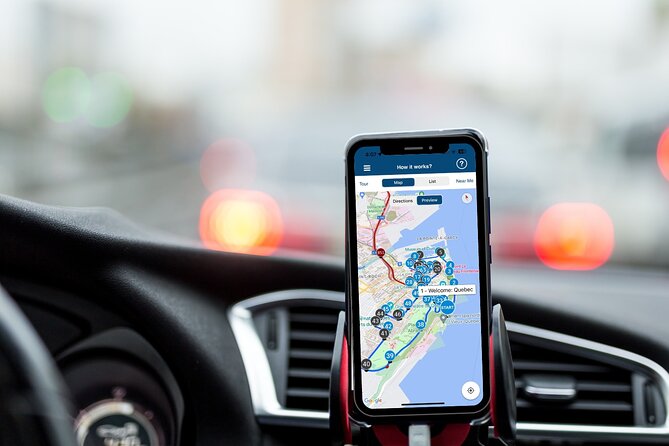
Reviewed · AUDIO TOURS
Quebec City Self-Guided Driving Audio Tour
Quebec City is made for wandering, but this self-guided driving tour gives you a useful overview before you tackle its steep streets on foot. From the Saint Lawrence waterfront, you follow a 73-mile route through Old Quebec, Parliament Hill, the Plains of Abraham, and Grande Allée, with more than 34 audio stories playing as you drive.
I like two things right away: one purchase covers the whole car, and the audio remains yours forever. You can pause for lunch, repeat the route on another trip, or listen again at home. The main concern is city traffic and road closures. If you leave the route, the narration may stop and the app does not provide the same quick recovery that a live guide would.
In This Review
- Key points to know before you book
- Starting beside the Saint Lawrence River
- Old Quebec and the oldest shopping district
- Place Royale and the French royal connection
- City Hall, the old prison, and Quebec’s walls
- Churches with stories older than their buildings
- The clock and the city’s public spaces
- Parliament Hill and Quebec’s government
- The Plains of Abraham and the Citadelle
- Art at the Musée des Beaux-Arts
- Finishing along Grande Allée
- How the timing really works
- Price, group size, and practical value
- Who will get the most from this Quebec City tour?
- Should you book it?
- FAQ
- How much does the Quebec City Self-Guided Driving Audio Tour cost?
- How long does the tour take?
- Where does the tour begin?
- Where does the tour end?
- Is the tour guided in person?
- Does the tour work without phone service?
- Is admission to attractions included?
- What devices and car connections are recommended?
Key points to know before you book
- More than 34 stories across a 73-mile route: You get much more than a short loop around the old town, although the full route may take longer than the stated one to two hours if you stop often.
- Old Quebec begins at the waterfront: The tour connects the Saint Lawrence River with the city’s stone streets, churches, walls, and grand public buildings.
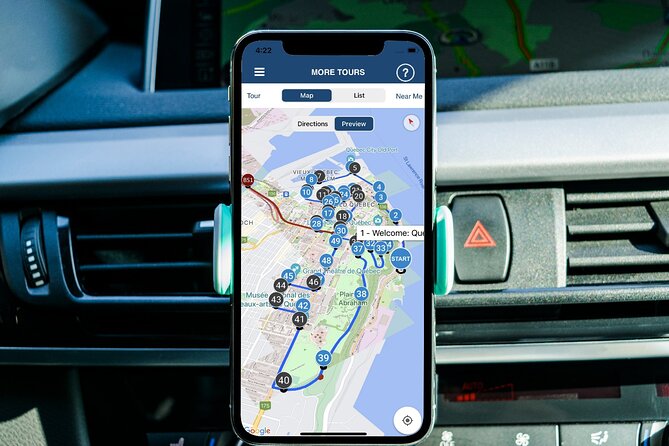
- Location-triggered audio works hands-free: After downloading the tour, stories begin as you reach their points, so you do not need to keep checking your phone.
- $16.99 covers up to four people: For a carload, this can cost less than several individual tickets for a conventional sightseeing tour.
- Lifetime access has real value: You can use the tour on any day, on future trips, and as many times as you wish.
- Road closures require patience: Construction, festivals, and blocked streets can interrupt the route, especially in central Quebec City.
Starting beside the Saint Lawrence River

The tour begins at 130 Rue des Sapeurs, near the waterfront. No guide meets you there, so you need to arrive with the Action Tour Guide app installed, the tour downloaded, and your phone connected to the car’s stereo if possible.
That preparation matters. Download the tour while you have strong Wi-Fi or cellular service. Once the route is stored on your phone, the audio and maps work offline. This is especially helpful if your mobile signal weakens near the old city or if you do not want to use roaming data.
The opening setting gives you a good sense of Quebec City’s character. The Saint Lawrence is not just a scenic backdrop. It explains why this place grew into a major port and military center, and why the city developed above the river on a high bluff.
The audio is in English and is designed to play automatically as you reach each point. You can connect your phone through Bluetooth, USB, or AUX. Apple CarPlay is supported for audio playback, while Android Auto support is still listed as forthcoming. Headphones are better suited to walking, but for this driving route, your car speakers are the practical choice.
A few more Quebec City trips to weigh up
- Old Town Quebec Secrets: Private Exploration Game and Tour
★ 4.0 · 13 reviews - Old Quebec Scavenger Hunt and Highlights Self Guided Audio Tour
★ 4.0 · 8 reviews - Kayak/Paddleboard Rouge River – Self Guided Descent
★ 4.5 · 7 reviews
Old Quebec and the oldest shopping district
The route moves through the historic quarter where Quebec City looks more European than North American. Stone facades, narrow cobbled streets, old fortifications, and buildings dating to the 17th century give this area its special look.
One early stop is Rue du Trésor. This small street is part of Old Quebec’s old commercial world and helps introduce the city’s layered past. The audio puts the buildings around you into context instead of leaving you to admire them without knowing what you are seeing.
The quarter is also described as the oldest shopping district in North America. That makes this portion useful for two reasons. You get a history lesson, and you finish with a clear idea of where to return for a slower walk, browsing, and a meal.
Driving Old Quebec can be the trickiest part of the experience. Streets may be narrow, busy, blocked, or difficult to follow. I would treat this section as an orientation route rather than a relaxed drive. Keep the volume high enough to hear the instructions, obey the speed limit, and do not try to study the phone while moving.
Place Royale and the French royal connection
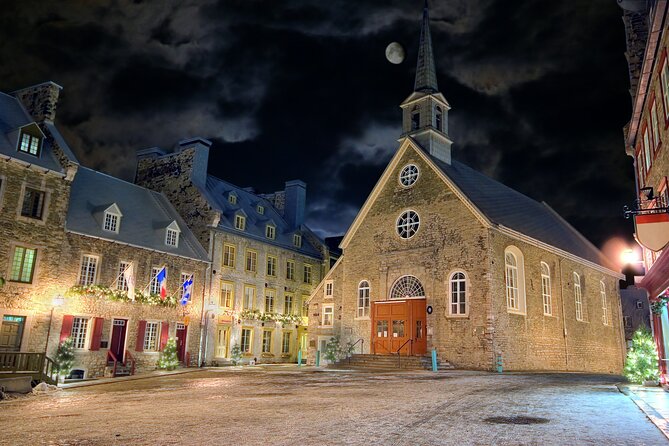
Place Royale owes its existence to Louis XIV, the French king whose policies shaped Quebec’s development. The narration uses this landmark to explain the French connection and the unusual ways the king influenced the city from across the Atlantic.
This is one of the more useful historical moments in the tour because it connects a handsome square to a person and a political system. You are not just looking at old stone. You are hearing why the city took the form it did.
The audio approach works best when you glance at the included photographs before or after driving. One particularly positive feature of the app is the images that appear on screen with the narration. They can help you identify a building or recall a detail later, though you should only look at them when safely parked.
City Hall, the old prison, and Quebec’s walls
The route then takes you past Quebec City Hall, an imposing building that combines Second Empire and chateau-style design. These styles were popular in the late 19th century, and the building gives you a quick lesson in how Quebec expressed civic pride through architecture.
Nearby, a historic structure now used by the Literary and Historical Society of Quebec was once the city’s first prison. A carriage house close by offers horse-drawn carriage rides, so you can note the option and decide later if it fits your plans.
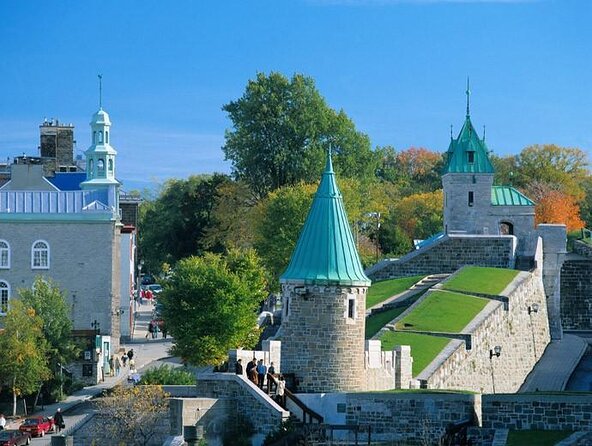
The drive along the stone fortifications is one of the strongest sections. Quebec’s walls date mainly to the 1820s and reveal the city’s military importance. They also help explain why the old district received UNESCO World Heritage status.
I like this part because the walls are both an attraction and a practical guide to the city’s shape. You can see where the fortified town ended and the newer city began. If you later walk Old Quebec, the fortifications give you a clear sense of direction.
Same province, a completely different day out:
- Quebec City Walking Tour
★ 5.0 · 4,716 reviews - Quebec City: Guided Tour of Fairmont Le Château Frontenac
★ 4.7 · 3,027 reviews - Québec City: Guided Sightseeing River Cruise
★ 4.4 · 3,000 reviews - Half-Day Trip to Montmorency Falls and Ste-Anne-de-Beaupré from Quebec city
★ 4.0 · 2,718 reviews
Churches with stories older than their buildings
The tour passes a cathedral whose present building dates to 1923, while the church itself reaches back to 1647. The audio also points out a door blessed by Pope Francis in 2014.
That small detail is exactly the kind of fact that makes a drive more memorable. You might pass the cathedral quickly, but afterward you will understand that the current structure is only one chapter in a much older religious story.
Holy Trinity Church offers another interesting contrast. It was the first Anglican church built outside the British Isles and is one of the few churches in Quebec that has never burned down. In a city where fire, rebuilding, and changing empires shaped so many buildings, that is worth hearing as you pass.
The tour does not include admission tickets, reservations, or attraction passes. If a church or museum catches your eye, you will need to arrange entry separately. The audio is best viewed as a guide to the city, not a ticketed sightseeing package.
The clock and the city’s public spaces
A huge Richard Mille clock appears along the route. Its construction took six years, and Switzerland’s Jura region gave it to Quebec City for the 400th anniversary of the city’s founding.
It is an unusual modern detail among so many old buildings. The story gives you a break from military and religious history and shows how Quebec City continues to mark its identity through public art and gifts.
The drive also reaches a large park that has hosted major concerts by Metallica, The Rolling Stones, and Paul McCartney. The park offers a welcome change from stone streets and formal buildings. Depending on traffic and your pace, you might want to stop here for a short break.
Another notable building dates to 1886 and commemorates the people involved in creating Quebec. Statues on its facade represent First Nations people, explorers, soldiers, and others. Its towers refer to important figures in the city’s past.
This is a good example of why an audio tour helps. A facade filled with statues can be hard to interpret on your own. The narration gives you a reason to look up and notice the details.
Parliament Hill and Quebec’s government
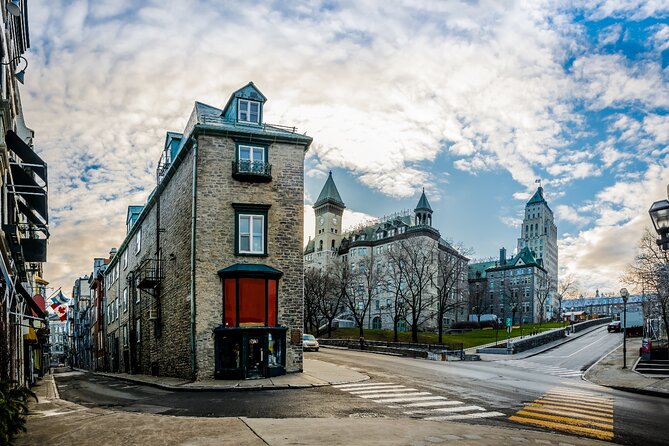
Parliament Hill is a brief but important stop, listed at about 10 minutes. Here you pass the seat of Quebec’s provincial government and hear about Canada’s provincial governmental structure.
For anyone who knows Canada mainly through its federal politics in Ottawa, this section adds useful context. Quebec has its own provincial government, legislature, and political traditions. The buildings around Parliament Hill also give the drive a formal, grand feel.
Do not expect a full government tour or interior visit. Admission is not included, and this experience focuses on stories from the road. If you want to see inside, you will need to plan that separately and check reservations on your own.
The Plains of Abraham and the Citadelle
From the Plains of Abraham, you can see the Citadelle, the fortress built in the 1820s when Quebec officials feared an attack from the United States. The setting links open parkland with a very serious military purpose.
The Plains themselves are also tied to the battle between the English and French in the 18th century. The tour later points out Terrasse Grey, which may look like a simple field but was the site of a pitched battle.
These stories give the open spaces meaning. Without them, the parks can seem like pleasant stretches of grass between attractions. With the narration, you understand why the ground mattered and how military concerns shaped the city.
The Citadelle is especially useful for families and first-time visitors because it makes the city’s defensive story easy to picture. You see the fortress, the high ground, and the river together. The tour does not include entry to the Citadelle, so treat this as a drive-by introduction.
Art at the Musée des Beaux-Arts
The route passes the Musée des Beaux-Arts, home to more than 38,000 works of art. Its collection covers Quebec art from the 17th century through the modern era.
Art lovers may want to pause the driving tour and give the museum its own block of time. The audio provides a reason to stop, but it cannot replace an indoor visit. You will need to buy admission separately if you choose to enter.
For everyone else, the museum still helps broaden the tour beyond old buildings and battles. Quebec City is not only a colonial and military center. It also has a long artistic life, and the museum gives you a place to explore that side of the city.
Finishing along Grande Allée
The tour ends on Grande Allée, one of Quebec City’s most popular streets. Shops, restaurants, cafes, and other stops line the route, making it a sensible place to finish.
This ending works well because it leaves you in an area where you can continue without another drive. You can stop the narration, park, and choose your next activity based on your mood. It is also a good place to pause for food after the route.
Grande Allée is listed as a 15-minute stop, but you should not feel pressured to move on. The main benefit of a self-guided tour is control. Pause the audio, take a break, or return to a section later.
How the timing really works
The stated duration is about one to two hours, but the route covers more than 73 miles and includes over 34 audio stories. Those figures do not fit neatly into a single uninterrupted drive if you stop for photos, museums, meals, or detours.
I would plan for the short timing only if you want a broad, mostly continuous overview. If you want to walk Rue du Trésor, visit the Musée des Beaux-Arts, inspect the fortifications, or stop at Grande Allée, allow more time.
The app lets you pause anywhere and resume later. You can also skip stories, replay sections, and explore bonus content when available. That flexibility is more important than the stated duration. You control the pace instead of following a bus schedule.
One user found the tour worth repeating twice and revisiting selected sections several times. That makes sense with lifetime access. You can use it as a first-day orientation, then replay only the Old Quebec or Parliament Hill sections after you know the streets better.
Price, group size, and practical value
At $16.99 per group of up to four, the price is easy to justify for a family or small group with a car. You are paying once rather than buying four individual tickets, and there is no expiry date.
The value is strongest if you want freedom. You can start any time during the stated operating period, pause for snacks and photos, and use the tour again on another day or another trip. You also avoid committing to a fixed departure time.
A live guide offers advantages this product cannot match. A person can answer questions, adjust the route, and explain what to do when a street is closed. The audio provides short stories at set points, then may leave silence until the next location.
That limitation became clear when road closures and special events made the route difficult to follow. Once off course, the audio may stop and will not necessarily guide you back. Before starting, check local road conditions and be prepared to skip a section rather than force the route.
Free cancellation is available if you cancel at least 24 hours before the start time. Changes or cancellations within 24 hours are not refunded.
Who will get the most from this Quebec City tour?
I would choose this tour if you have a car, prefer independent sightseeing, and want historical context without joining a group. It suits families, couples, and small groups who like stopping when they please.
It is also useful for a return visit. Since access never expires, you can use it as a refresher before exploring areas you missed the first time.
I would be more cautious if you dislike navigation, plan to drive during a major festival, or want a guide who can respond to unexpected road changes. Old Quebec’s streets can be difficult, and the app depends on staying near the intended route.
For the best experience, download everything in advance, test the audio connection, and begin with a full phone battery. Use the route at a safe speed, and park before checking photographs or changing settings.
Should you book it?
Book this Quebec City audio tour if you want an affordable, flexible introduction that covers far more than the postcard center. Its best features are the automatic storytelling, offline maps, photographs on the phone screen, and lifetime access for one low carload price.
Skip it if you want a human guide, detailed walking commentary, or guaranteed navigation through road closures. For independent drivers who prepare before leaving, it is a useful orientation tool. Just think of it as a narrated framework for exploring Quebec City, not a replacement for parking the car and walking through the old streets yourself.
FAQ
How much does the Quebec City Self-Guided Driving Audio Tour cost?
The tour costs $16.99 per group, with up to four people included in one purchase.
How long does the tour take?
The stated driving time is about one to two hours. The route covers more than 73 miles and includes over 34 audio stories, so stops, photos, meals, and museum visits can make your outing longer.
Where does the tour begin?
It begins at 130 Rue des Sapeurs, Québec, QC G1K 0E4, Canada.
Where does the tour end?
The route ends on Rue Joly de Lotbinière, Québec, Canada. The final featured area is Grande Allée.
Is the tour guided in person?
No. This is a private, self-guided activity, and no guide meets you at the starting point. Audio stories begin automatically when you reach the correct locations.
Does the tour work without phone service?
Yes. You must download the tour while you have strong Wi-Fi or cellular service. After downloading, the audio and offline maps work without cellular or Wi-Fi access.
Is admission to attractions included?
No. Attraction admission, entry tickets, reservations, and passes are not included.
What devices and car connections are recommended?
An iPhone using iOS 15 or later, an Android device using version 9 or later, or an iPad or tablet with GPS and cellular connectivity is recommended. You can connect the phone to your car stereo through Bluetooth, USB, or AUX. Apple CarPlay supports audio playback.
Just added around Quebec City
- Walking tour of Old Lévis, Quebec with tasting★ 4.5 · 7 reviews
- 1.5-Hour Guided Snowmobiling Adventure★ 5.0 · 68 reviews
- ATV Side by Side Guided 4×4 Tour★ 5.0 · 13 reviews
- Ultimate Dog Sledding Tour – Day trip from Ottawa & Gatineau★ 5.0 · 26 reviews
- Petite Nation Wine & Cider Tour – Day Trip From Ottawa & Gatineau★ 5.0 · 15 reviews
- Half-Day Orleans Island Small-Group Sea Kayaking Tour★ 4.0 · 24 reviews
- Quebec City – Tandem Bike Rental on Ile d’Orléans★ 5.0 · 10 reviews
- Haunted Walk Experience at the Mackenzie King Estate★ 4.5 · 12 reviews
Audio Tours, compared.


Niagara: Behind The Falls, Skylon Tower Ticket & Tesla Audio Tour
Read our review →

A 7th-Gen Local’s View of Downtown Charlottetown: An Audio Tour
Read our review →
Halifax Churches, Gardens & Graveyards: a Smartphone Audio Walking Tour
Read our review →
Browse the lists this tour appears in