

Reviewed · WALKING & GHOST TOURS
Toronto’s Waterfront: a Smartphone Audio Walking Tour
Toronto’s waterfront is a long, varied story told through factories, ferry terminals, public art, sports venues, parks, and broad lake views. This 4.5 km smartphone audio tour links those pieces in one easy walk, from Sugar Beach to Princes’ Gates at the Canadian National Exhibition grounds.
I like the freedom to stop for coffee, photos, or a longer look at the water without holding up a group. I also like the GPS map and automatic commentary, which give you more context than wandering alone. The main drawback is simple: you must bring a charged smartphone, and a phone speaker may be hard to hear near traffic or wind.
In This Review
- Key points to know before you go
- Why Toronto’s waterfront makes a good audio walk
- Starting at Sugar Beach and Toronto’s industrial waterfront
- Yonge Street, Jack Layton, and the ferry terminal
- Art, the Simcoe WaveDeck, and the city skyline
- HTO Park and a musical detour by Spadina Avenue
- Billy Bishop Airport and the route’s quieter western stretch
- HMCS York and the final approach to Princes’ Gates
- How the GPS audio system works
- Timing, price, and practical value
- Who should choose this Toronto waterfront tour?
- Should you book the Sugar Beach to Princes’ Gates walk?
- FAQ
- Where does the Toronto waterfront audio tour start?
- Where does the tour end?
- How long does the tour take?
- Is the tour available in other languages?
- Do I need mobile data during the walk?
- Are attraction tickets included?
Key points to know before you go
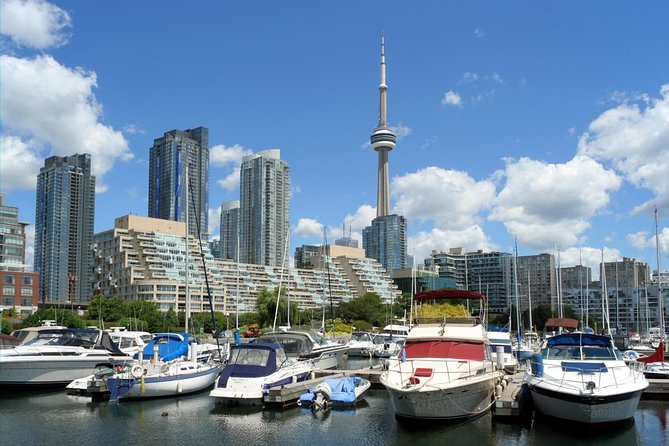
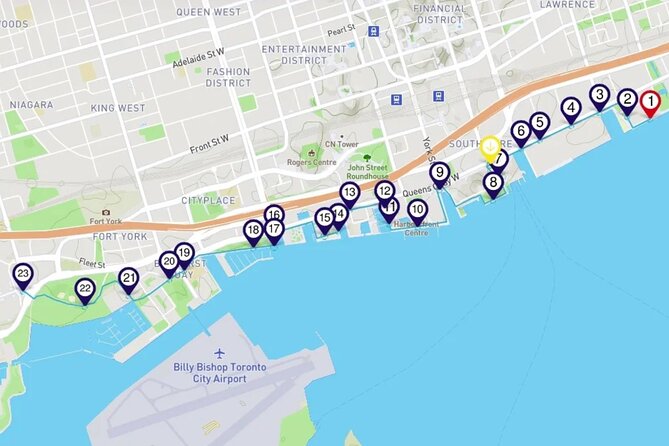
- Sugar Beach to Princes’ Gates: The route crosses much of Toronto’s central waterfront, with the option to walk in either direction.
- GPS audio that plays by location: Commentary starts as you approach each point of interest, while the live map shows your position and the next stop.
- Twenty named stops: Expect landmarks ranging from Redpath Sugar and One Yonge Street to the CN Tower, Toronto Music Garden, HMCS York, and the Princes’ Gates.
- A flexible private experience: There is no group, guide to keep pace with, or fixed start date. You can pause and resume whenever you like.
- A low-cost introduction: At $8.21 per person, the tour costs far less than a conventional guided walk, though attraction admission is not included.
- A walk that can take longer than advertised: The stated time is about 45 minutes to 1 hour 30 minutes, but stopping for views and attractions can stretch it beyond two hours.
Why Toronto’s waterfront makes a good audio walk
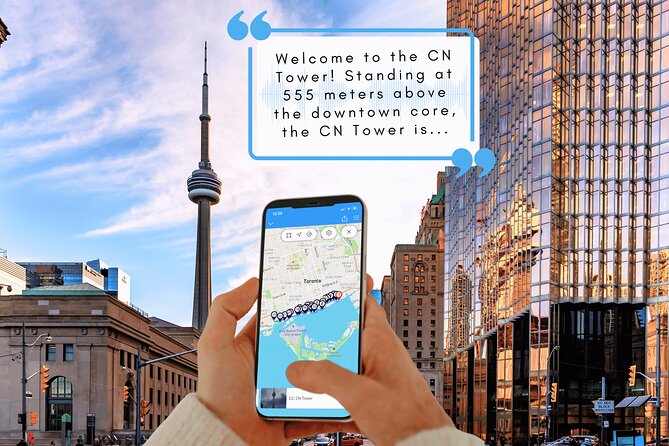
Toronto’s lakefront is not one single sight. It shifts from working waterfront to skyscraper views, from ferry traffic and sports venues to gardens, trails, and public art. That variety is what makes this route useful for a first look at the city.
The audio format gives you a bit of structure without taking away your independence. You are not simply following a line on a map. As you reach each location, the guide explains what you are seeing, then offers a location-based trivia question. You tap your guess on the phone before moving on.
That small game element helps keep the walk active, especially if you are exploring with children or want something more engaging than a series of recorded facts. Still, the tour is mainly an orientation walk. It is not designed as a full visit to the CN Tower, the Power Plant, Rogers Centre, or any other attraction.
The route is private in the practical sense: only your group uses the tour. You do not have to share a guide with strangers, and you can begin when it suits your day. The tour is available in English.
More Walking & Ghost Tours in Toronto
- Show me the City! A Small Group Walking Tour of Toronto
★ 5.0 · 621 reviews - Toronto Distillery District Walking Tour
★ 5.0 · 327 reviews - Toronto: City Highlights Walking Tour | 3-Hour
★ 4.6 · 306 reviews
Starting at Sugar Beach and Toronto’s industrial waterfront
Sugar Beach is the opening point, at St. Lawrence East Bayfront. It is an easy place to begin with a view toward the lake and a reminder that Toronto’s waterfront has long been tied to industry and shipping.
The next stop at Lower Jarvis Street and Queens Quay East sets up that story. The commentary explains how industry helped shape Toronto’s growth, giving you useful context before you reach the Redpath Sugar factory.
Redpath Sugar is one of the route’s most distinctive sights. The factory is not a polished tourist attraction, but that is exactly why it matters. It shows the working side of the waterfront, where production and transport helped build the city.
The tour points out the factory and explains its background in a short segment of about five minutes. That length is helpful here. You get enough information to understand why the building matters without being held in place for a long lecture.
From there, you reach One Yonge Street, home of the Toronto Star Building. The audio connects the skyscraper with the newspaper that has been producing papers since 1892. This stop gives the walk a different angle, moving from factories to the institutions that shaped public life in the city.
Yonge Street, Jack Layton, and the ferry terminal

At Yonge Street and Queens Quay West, the tour turns to one of Toronto’s best-known streets. The commentary notes that Yonge Street once held the Guinness World Record for the longest road.
This is a good example of the tour’s approach. It gives you a memorable fact tied to the place under your feet, rather than offering only a general description of Toronto. The stop itself is brief, so you can keep moving after the explanation ends.
Next comes the statue of Jack Layton and the nearby Jack Layton Ferry Terminal. The audio introduces Layton and explains the connection between the statue and terminal. This section adds a human and political note to a route that could otherwise focus only on buildings and views.
At York Street and Queens Quay West, you get a good look toward the Toronto Islands. The view is one of the walk’s natural pauses. I would take a little extra time here, since the audio stop is only an introduction and not a substitute for simply looking across the water.
The tour is at its best when it gives you a fact, then leaves room for you to enjoy the setting. You are not rushed from one marker to the next.
Art, the Simcoe WaveDeck, and the city skyline

The Power Plant Contemporary Art Gallery is the next major point of interest. The audio explains why you might want to visit, but admission is not part of the tour. If contemporary art interests you, this is one of the places where you may want to stop the walk and make a separate visit.
The Simcoe WaveDeck follows. It is a public artwork that looks warped, though the uneven shape is intentional. The commentary explains the piece and invites you to walk on it.
This is a particularly good stop for a short break or a few photographs. It also shows how the waterfront mixes practical public spaces with unusual art. You do not need a ticket to experience the WaveDeck itself.
The CN Tower is the route’s biggest landmark. It is hard to miss, so the audio uses the sight as a chance to explain the tower and its place in Toronto’s skyline. The tour does not include admission, so plan separately if you want to go inside.
That distinction matters. At $8.21, the tour gives you orientation and background, not entry to paid attractions. You can decide after hearing the commentary if the CN Tower deserves a separate block of time and money.
Rogers Centre comes next, home of the Blue Jays. The tour adds a sports connection to the waterfront route and helps you understand the cluster of major venues near the lake. Again, admission is not included, but you can see the building from the route.
Same province, a completely different day out:
- Toronto: Niagara Falls Day Tour with Optional Boat Cruise
★ 4.6 · 3,178 reviews - Niagara Falls Day Tour from Toronto
★ 5.0 · 2,889 reviews - Toronto: Casa Loma Entry Ticket
★ 4.7 · 2,705 reviews - Niagara Falls Canada Day Tour From Toronto + Boat Cruise Option
★ 5.0 · 2,576 reviews
HTO Park and a musical detour by Spadina Avenue
HTO Park offers a more relaxed section of the walk. The commentary explains the park and the source of its unusual name. This is a pleasant place to slow down, especially if you have spent much of the route among towers, roads, and large venues.
At Spadina Avenue and Lake Shore Boulevard West, you get a view of one of the city’s busiest streets. The audio also includes a song from the 1980s about the Spadina Bus.
That musical touch gives the tour some character. It is not a dry list of dates and building names. Small details like this can help a place stick in your memory, especially when the route covers many stops in a short time.
The Toronto Music Garden is one of the more unusual stops. Its design has a distinctive story, and the commentary explains how the garden came together. You can stroll through it while listening, then pause the tour if you want more quiet time.
I like this part of the route because it changes the mood. After the CN Tower, Rogers Centre, roads, and city views, the garden gives you a softer setting without requiring a separate trip.
Billy Bishop Airport and the route’s quieter western stretch

At Queens Quay West and Bathurst Street, the tour points toward Billy Bishop Airport. The airport sits on the island, giving you another clear reminder that the waterfront is an active transport corridor, not just a recreational path.
The commentary explains the airport while giving you a view across the water. It is a useful stop if you are unfamiliar with Toronto’s geography and want to understand how the lake, islands, airport, and downtown fit together.
Little Norway Crescent brings a smaller park and a wartime connection. The audio explains how the park was created to commemorate World War Two. This stop is less grand than the CN Tower or Rogers Centre, but it adds another layer to the route.
From here, the tour follows the Waterfront Trail. You learn about the trail as you walk along it, then continue onto the Martin Goodman Trail, a waterfront path stretching for more than 20 km.
The walk covers only part of that larger system. This is worth knowing if you are choosing the tour for exercise. It is a sightseeing route with walking built in, not a long-distance trail excursion.
HMCS York and the final approach to Princes’ Gates

HMCS York is the naval stop. The commentary points out this waterfront fixture, in place since 1959, and explains its purpose. It gives the route a military connection alongside its industrial, cultural, sporting, and transport themes.
The final named stop is Princes’ Gates, at the entrance to the Canadian National Exhibition. The audio explains the gates and the annual fair held inside them.
Ending here gives the route a clear finish. You have moved from Sugar Beach and the industrial east waterfront through downtown landmarks, parks, art, and trails, then into the western end of the central waterfront.
The endpoint is listed as 800 Lake Shore Boulevard West. The tour can also be completed in the opposite direction, and the experience is described as very similar either way. If your plans begin near the CNE, starting at Princes’ Gates may save you a return trip.
How the GPS audio system works

Download the tour over Wi-Fi before you leave. Once it is on your device, no mobile signal or data is needed during the walk. That is useful along a long outdoor route, where a poor connection can make streaming audio annoying.
The live GPS map shows where you are and where to go next. When you approach a point of interest, the commentary plays automatically. You do not need to keep checking a written route, though you should still pay attention to traffic, crossings, bikes, and other people using the waterfront.
You can also stop and start the tour anywhere along the route. The tour is yours to keep and use at any time, rather than only on the date selected at booking.
Headphones are optional. The audio can play through your phone speaker, but headphones may make it easier to hear near busy roads or in windy areas. Bring your own smartphone or tablet, since neither the device nor headphones are included.
The number of people selected at booking equals the number of devices that can download the tour. That is an important detail for couples or families who want separate audio. One device can work for a small group, but only one person may hear it clearly at a time unless you share headphones.
Timing, price, and practical value
The price is $8.21 per person. For that cost, you get a mapped route, automatic audio, background on 20 named stops, a trivia game, customer support by phone and email, and the freedom to use the tour on your own schedule.
That is strong value if you want a first orientation to Toronto and do not need a live guide. A traditional private walk would normally cost much more, while a free stroll would give you the views but none of the explanations.
The stated duration is 45 minutes to 1 hour 30 minutes. In practice, plan extra time if you stop at the WaveDeck, take photos of the CN Tower, look toward the islands, pause in Toronto Music Garden, or visit an attraction along the way.
One detailed account put the walk at a little over two hours. That makes sense for a 4.5 km route with many stops, even though each commentary segment is listed at about five minutes. If you rush, you will miss much of the pleasure. If you linger, you can turn the tour into a relaxed half-day waterfront outing.
The experience is available every day from midnight to 11:30 p.m., so you have broad freedom over timing. The official cancellation rule allows a full refund if you cancel at least 24 hours before the start time. Changes or cancellations within 24 hours are not accepted for a refund.
Who should choose this Toronto waterfront tour?
I would choose this tour if you dislike crowded group walks, prefer setting your own pace, or have a gap between larger activities. It also works well for a first visit, since the route introduces major landmarks without asking you to commit to admission tickets.
It suits independent walkers who enjoy listening while moving. You can pause for lunch, stop at a park, or spend longer at a point that catches your interest.
It may be less suitable if you want a personal conversation with a guide, detailed answers to follow-up questions, or a tightly focused visit inside one attraction. The recorded format gives you freedom, but it cannot react to your interests in the way a live guide can.
You should also be comfortable using a smartphone and following a GPS map. Most people can participate, service animals are allowed, and the route is near public transportation, but the supplied details do not promise a particular surface or step-free route at every point.
Should you book the Sugar Beach to Princes’ Gates walk?
Book it if you want an inexpensive, flexible way to get your bearings along Toronto’s waterfront. The best parts are the automatic GPS commentary, the mix of industrial and cultural sights, and the ability to take two hours or more if the views tempt you to slow down.
Skip it if you are looking for attraction admission, a live guide, or a short route with no phone use. For $8.21, though, it gives you a lot: a clear 4.5 km path, useful city context, trivia, and the freedom to make the waterfront your own.
FAQ
Where does the Toronto waterfront audio tour start?
The tour starts at Sugar Beach in St. Lawrence East Bayfront, Toronto, Ontario.
Where does the tour end?
The endpoint is Princes’ Gates, the entrance to the Canadian National Exhibition, at 800 Lake Shore Boulevard West.
How long does the tour take?
The stated duration is about 45 minutes to 1 hour 30 minutes. You can take as long as you like, and stopping for views or attractions may extend the walk beyond two hours.
Is the tour available in other languages?
The tour is offered in English.
Do I need mobile data during the walk?
No. You should download the tour over Wi-Fi before starting. After that, no signal or mobile data is required during the tour.
Are attraction tickets included?
No. Admission to attractions such as the CN Tower and Rogers Centre is not included. The tour provides audio commentary and directions, while any attraction visit must be arranged separately.
More Self-Guided Tours in Toronto
- Toronto Old Town: Self-Guided Dark History Walking Game
★ 5.0 · 15 reviews - Kensington Market and Chinatown: A Self-Guided Tour
★ 4.5 · 7 reviews - Toronto: True Tales of Toronto Harbour Audio Boat Tour
★ 5.0 · 5 reviews - Private Self-guided River Rafting Tour in Calgary
★ 5.0 · 182 reviews
More Walking Tours in Toronto
- Old Town Toronto Highlights 3 Hour Walking Tour | Gratuity-Based
★ 4.5 · 290 reviews - Toronto: Dark History Nighttime Walking Tour
★ 4.7 · 273 reviews - Toronto: Distillery District Historic Walking Tour
★ 4.8 · 267 reviews - Ghost Tour of Toronto Original Haunted Walk
★ 4.5 · 185 reviews
Just added around Toronto
- Toronto Craft Brewery Tour★ 5.0 · 97 reviews
- Canada eSIM | 3-30 days | Daily data | QR code★ 4.0 · 12 reviews
- Underground Toronto PATH Tour★ 4.5 · 6 reviews
- Handcrafted Donuts of Toronto: A Sweet City Walking Tour★ 5.0 · 141 reviews
- Customizable Walking Tour of Toronto’s Hidden Gems★ 5.0 · 15 reviews
- Pottery wheel class in Toronto Bay&Dundas★ 4.5 · 5 reviews
- Toronto’s Longest Running Improv Theatre – Marquee Show★ 5.0 · 5 reviews
- Toronto Airport Private Transfer to Downtown★ 4.5 · 10 reviews
Walking & Ghost Tours, compared.


Old Quebec City: Grand Walking Tour with Private Option
Read our review →
The Original Old Montréal Walking Tour by Guidatour
Read our review →
Old Montreal Small-Group Walking Tour | Max 10 | by MTL Detours
Read our review →
Old Quebec Classique Walking Tour with Funicular
Read our review →
Old Quebec City Food Tour with 10+ Autentic Local Tastings
Read our review →

Browse the lists this tour appears in