
Reviewed · WALKING & GHOST TOURS
Discover Downtown Regina: a Smartphone Audio Walking Tour
Regina’s downtown tells its story in stone, brick, churches, banks, railway buildings, and public squares. This self-guided walk lets you hear short pieces of that story as you reach each place, from City Hall and Hotel Saskatchewan to the Regina Riot site and the old No. 1 Fire Hall.
I like the automatic geolocation, which can start the right audio as you pass a stop, and the freedom to tour with only your own group. I also like the low price and offline format. The main caution is route reliability: construction once forced a participant to miss about five stops, and one section passed through an area that felt uncomfortable.
In This Review
- Key points to know before you walk
- Start at Queen Elizabeth II Court and Regina City Hall
- Churches and public buildings around Victoria Park
- Newspapers, banks, and Regina’s commercial core
- McCallum Hill, the cenotaph, and two important names
- Victoria Park and Memorial Hall
- Canada Life, the telephone exchange, and St. Paul’s
- Mosaic Stadium and modern Saskatchewan institutions
- The Regina Riot and the final downtown buildings
- Extra points beyond the main downtown sequence
- How the self-guided format works in real use
- Is $6.72 good value?
- Who should book this Regina walk?
- FAQ
- How long does the Discover Downtown Regina tour take?
- Where does the tour begin?
- Where does the tour end?
- Is mobile data required during the walk?
- Is this a private tour?
- What is included in the price?
- Should you book it?
Key points to know before you walk

- GPS-triggered audio: Commentary begins automatically as you reach the listed locations, so you do not need to keep checking a screen.
- Thirty downtown stops: The route covers civic buildings, churches, memorials, old businesses, railway sites, and modern Regina landmarks.
- Download before leaving: Once the tour is saved over Wi-Fi, it does not require mobile data or a signal during the walk.
- Optional trivia: Each stop includes a location-specific question, giving children and curious adults something to do beyond listening.
- Private and flexible: Your friends or family form the group, and you can take as long as you like to finish.
- A very low-cost introduction: At $6.72 per person, this is inexpensive for a roughly 90-minute to two-hour orientation of central Regina.
Start at Queen Elizabeth II Court and Regina City Hall
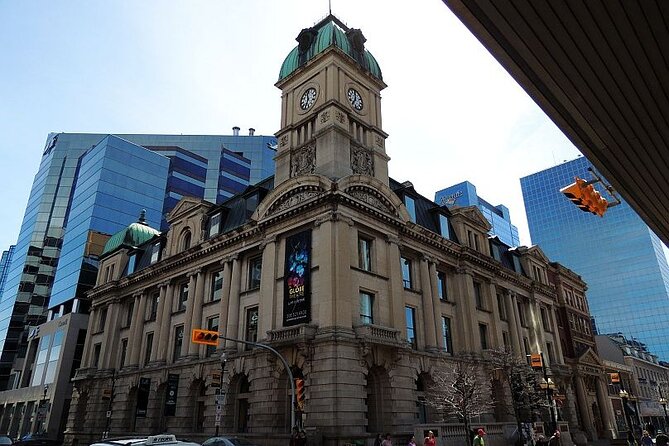
The walk begins at Regina City Hall, at 2476 Victoria Avenue, in Queen Elizabeth II Court. This is a useful starting point because the site gives you an immediate sense of Regina’s civic center, including the city hall building and a 16-storey office tower within the block.
The opening commentary is planned for about five minutes. That short format continues throughout the experience. You are not signing up for long lectures. Instead, you get compact explanations that are easy to follow while looking at the building in front of you.
From there, the route moves through the former Sherwood Department Store site and the Balfour Apartments. The department store stop offers a glimpse into downtown shopping life, while the Balfour Apartments, completed in 1930, provide a different look at the city’s early residential architecture.
I like this early change of pace. You move from government to commerce to housing in only a few blocks, which helps you see downtown as a working city rather than a string of isolated monuments.
More walking & ghost tours in Canada:
- Quebec City Walking Tour
★ 5.0 · 4,716 reviews - Old Quebec City: Grand Walking Tour with Private Option
★ 4.8 · 2,609 reviews - The Original Old Montréal Walking Tour by Guidatour
★ 4.5 · 2,217 reviews
Churches and public buildings around Victoria Park
The route then reaches First Baptist Church, just south of Victoria Park. The church is described as notably large, and the audio gives you a reason to pause and look closely instead of simply passing it on the sidewalk.
Next comes the Land Titles Building, located near the Saskatchewan Sports Hall of Fame. It was the first public building commissioned by Saskatchewan’s new provincial government, making it a useful stop for understanding how the young province presented its authority.
Hotel Saskatchewan follows. Built in 1927 for the Canadian Pacific Railway, the hotel is now a municipal heritage property. Its railway connection matters because hotels such as this were closely tied to the growth of prairie cities and the movement of people, goods, and business.
Across from Victoria Park, the Federal Building provides another civic landmark. The Motherwell Building, at Victoria Avenue and Rose Street, adds a provincial and commercial layer to the route. Both stops reward you for looking at façades, corners, and the way public buildings were placed around the park.
The audio does not require admission to these sites. You are viewing them from public areas, so the tour remains inexpensive. The tradeoff is that the experience focuses mainly on exterior interpretation. You should not expect indoor access to every building.
Newspapers, banks, and Regina’s commercial core
The Leader Building, built in 1912, was the fourth home of the Regina Leader newspaper. This is one of the better stops for seeing how newspapers once occupied a central place in civic life and how a growing city needed its own daily voice.
Conexus Plaza shifts the story toward modern business. The building is home to Conexus Credit Union, and the commentary helps connect the older downtown core with Regina’s present-day financial institutions.
The Old Post Office is one of the oldest remaining structures in the downtown area. It is exactly the kind of place that is easy to overlook when walking alone, especially if you are focused on shops or traffic. A short audio explanation gives it a clear place in the city’s story.
The Northern Crown Bank is even more useful for architecture fans. It is a provincial heritage building and the oldest commercial building in Regina’s central business district. Nearby, the Willoughby and Duncan Building sits within the largest concentration of early commercial architecture in downtown Regina.
These stops are a strong part of the tour because they show how much history survives in ordinary city blocks. You are not only visiting major public landmarks. You are also being directed to older commercial buildings that could otherwise blur into the streetscape.
McCallum Hill, the cenotaph, and two important names
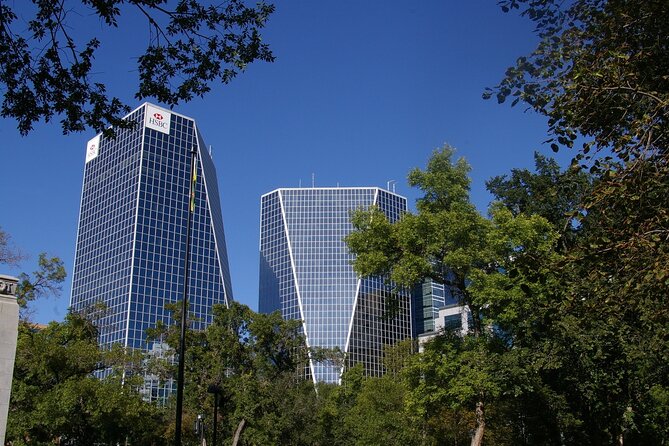
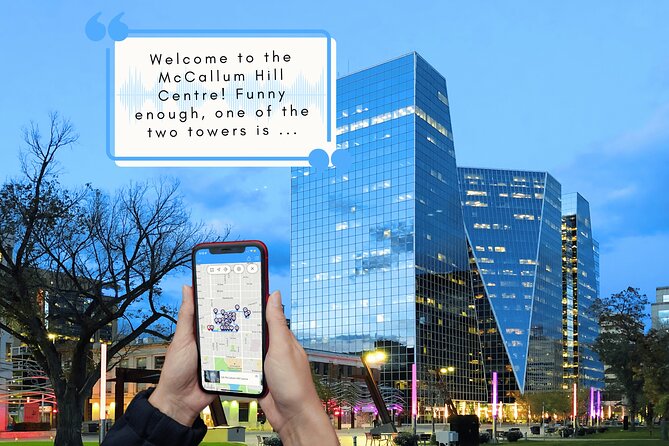
The McCallum Hill Centre brings you to one of Regina’s most recognizable modern forms, its twin towers. Tower One sits on the site of the original McCallum Hill building, once Regina’s tallest building and first skyscraper.
That stop gives the walk a useful time shift. You have just been looking at early banks and commercial blocks. Now you see how the city’s vertical profile changed as newer office buildings replaced or absorbed older downtown sites.
The Regina Cenotaph was originally built to honour Regina’s fallen heroes of the First World War. Memorials are often quiet places, and the audio provides the context needed to understand why this one occupies an important place in the city center.
The route also includes a reference to Sir John A. Macdonald, Canada’s first prime minister and a figure associated with Confederation. This is a brief historical stop rather than a full political discussion. If you want a more critical or detailed treatment of Macdonald’s legacy, you may need to supplement the tour elsewhere.
Knox-Metropolitan United Church is another major religious landmark. It is home to two of Regina’s oldest congregations and continues to play an important role in the city’s heritage. The scale of the church is hard to miss, but the congregation history gives the building more meaning than its size alone.
A few more Canada trips to weigh up
- Old Montreal Small-Group Walking Tour | Max 10 | by MTL Detours
★ 5.0 · 2,088 reviews - Gastown Historic Walking Food Tour
★ 5.0 · 1,863 reviews - Old Quebec Classique Walking Tour with Funicular
★ 5.0 · 1,317 reviews - Vancouver Lost Souls of Gastown Walking Tour
★ 5.0 · 1,273 reviews
Victoria Park and Memorial Hall

Victoria Park was originally a two-block public reserve set aside in 1883. It later became a recreation area and gathering place for families, and it remains one of the clearest pauses in the route.
This is a good place to slow down. The park breaks up the building-by-building rhythm and gives you room to consider how the city organized public space. You can also use the stop as a natural rest point, since the tour is not tied to a guide or fixed departure time.
Memorial Hall was built between 1947 and 1951. The building is connected with Royal Canadian Legion Branch 001, which was the first branch in Canada to receive a charter. That detail makes the stop more specific than a generic war memorial visit and ties the building to the organization’s national beginnings.
The Dunlop Art Gallery adds a cultural stop. It has locations in the Central and Sherwood libraries and has been part of the Regina public library system since the 1960s. This is a good reminder that the tour is not limited to old government buildings and military memorials. It also points you toward the city’s public arts life.
Canada Life, the telephone exchange, and St. Paul’s
The Canada Life Assurance Company Building dates to 1914 and once served as the Saskatchewan headquarters for the Ontario-based company. Its importance comes from both its age and its role in the expansion of business services across the province.
The Regina Telephone Exchange offers a different kind of history. Its value lies in its connection to the development and expansion of telephone service in Saskatchewan. This is a useful stop for anyone interested in infrastructure, since communication networks helped change how prairie communities worked and connected.
The Saskatchewan Revenue Building was built by the Saskatchewan Cooperative Elevator Company, one of the first major agricultural cooperatives in the province. This stop links downtown Regina to Saskatchewan’s farm economy and cooperative movement, a connection that can be missed if you only focus on architecture.
St. Paul’s Cathedral, constructed in 1894, replaced the city’s first St. Paul’s church. It is one of the older religious buildings on the route and helps anchor the story in Regina’s early years.
Taken together, these four stops broaden the walk. You get insurance, communications, agriculture, and religion, not just a parade of façades. The short audio clips are best treated as prompts for further exploration rather than complete lessons.
Mosaic Stadium and modern Saskatchewan institutions

Mosaic Stadium is home to the Saskatchewan Roughriders of the Canadian Football League. Even if you are not attending a game, the stop gives the route a distinctly local sports connection.
The supplied description includes a playful warning about going to a Roughriders game, suggesting that the audio is not written in a stiff museum style. That bit of humor may appeal to families and sports fans, though anyone wanting a serious stadium tour should note that this is an exterior point of interest, not a game ticket or behind-the-scenes visit.
The SGI stop covers Saskatchewan Government Insurance, created in 1945 as a provincial Crown corporation. It is another example of how the walk moves beyond old architecture to explain institutions that still shape daily life in Saskatchewan.
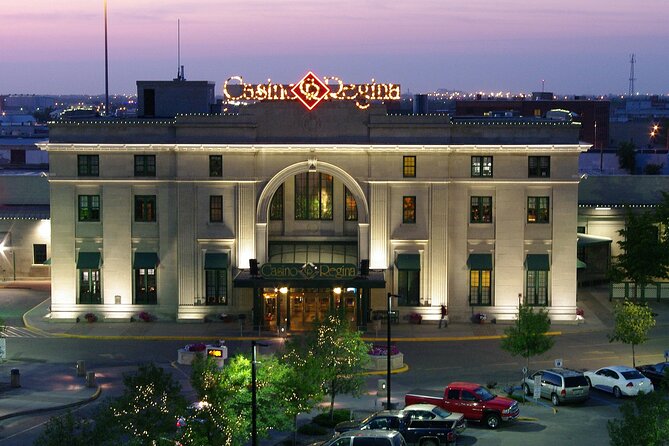
Union Station, built in 1911 by the Canadian Pacific Railway, once handled rail service and divisional headquarters functions. Its place on the route makes sense beside the Hotel Saskatchewan. Together, the two stops show how railways helped organize Regina’s business and civic center.
The Regina Riot and the final downtown buildings

The Regina Police Department site on Quance Street is tied to the 1935 Regina Riot. The stop points to the police headquarters as the location from which the event originated, giving you a direct connection between the street in front of you and a major episode in the city’s past.
The Old No. 1 Fire Hall was completed in 1921 and has a distinctive design. Fire halls are practical buildings, but this one shows how even essential city services received architectural attention in an earlier era.
The Municipal Justice Building is the route’s most uncertain stop. At the time of the recording, it had been slated for destruction, while local efforts were trying to save it. Its condition or availability may have changed, so you should be prepared for a site that is altered, closed, or no longer present as described.
The tour ends just north of the corner of Halifax Street and 11th Avenue, at 1550 11th Avenue. That makes the finish different from the start, so plan your return trip before setting out. The experience is near public transportation, but no transportation service or return transfer is included.
Extra points beyond the main downtown sequence
The material for the tour also references several additional Regina-area points of interest. These include an old stone castle, the Royal Canadian Mounted Police, Wascana Centre, Wascana Lake, the Saskatchewan Science Centre, and a site associated with exploring Saskatchewan and the wider world since 1906.
The exact order and relationship of these extra points are not as clearly laid out as the 30 downtown stops. Treat them as possible audio references or related attractions rather than assuming they are all part of one tight walking loop.
Wascana Centre is described as a landscaped park surrounding a 120-hectare lake in the heart of Regina. The Saskatchewan Science Centre includes experiments, stage shows, workshops, and the province’s only 3D IMAX Theatre. These places may be useful additions to your day, but attraction admission is not included, and access can vary by season or other conditions.
How the self-guided format works in real use
You receive a mobile ticket and download the tour over Wi-Fi before leaving. Once saved, the walk does not require data or a signal, which is especially useful if you are avoiding roaming charges or have a limited data plan.
The geolocation feature is the star of the format. As you approach a listed point, the commentary can begin automatically, so you can keep your attention on the street and buildings rather than constantly tapping through a menu.
Still, I would not rely on the route without preparation. Construction once sent the route through a closed or difficult street and caused about five stops to be missed. Before starting, check current street conditions, download the content, confirm your phone is charged, and keep the tour map or stop list available in case GPS behaves poorly.
One section was also described as passing through an area with visible homelessness and drug use. That is not necessarily a permanent condition, but it is a fair reason to stay alert, walk during a time that feels comfortable to you, and reroute if needed. The app cannot always react quickly to changing street conditions.
The tour is private, so you can travel with your own friends or family rather than joining strangers. It is offered in English, and optional trivia questions appear at each stop. Most people can participate, and service animals are allowed.
Is $6.72 good value?
At $6.72 per person, this is one of the cheaper ways to get a structured introduction to downtown Regina. You receive automatic commentary, trivia, customer support by phone and email, flexible dates, and access to the tour for future use on Tripvia Tours.
The strongest value comes from the combination of price and freedom. You can pause for photos, stop for food, spend extra time in Victoria Park, or skip a building that does not interest you. There is no fixed departure time and no time limit on completion.
The weaknesses are just as clear. There is no live guide to answer questions or adjust the route. Attraction tickets are not included, and recommended sites may be closed or inaccessible because of the season or circumstances beyond the operator’s control.
The audio clips are brief, roughly five minutes per stop. That works well for a casual orientation but may feel thin if you want detailed architectural analysis or a full account of Regina’s political and social history. I see this as a low-cost framework for exploring, not a replacement for a museum visit or private historian.
Who should book this Regina walk?
I would choose this tour if you want a flexible first look at downtown, especially if you are traveling with family or friends and do not want to match a guide’s pace. It also suits repeat visitors who prefer to pick only the buildings and subjects that catch their interest.
The trivia format should help keep younger walkers involved. History fans will appreciate the range, from the 1894 St. Paul’s Cathedral to the 1935 Regina Riot site, while architecture fans have plenty of commercial and civic buildings to examine.
I would think twice if you need a perfectly current route, indoor access, or a guide who can answer detailed questions. The reported construction problem is the biggest practical concern, and the uncertain status of the Municipal Justice Building shows why you should treat the route as flexible.
You can cancel for a full refund up to 24 hours before the start time. Cancellations or changes made within 24 hours are not refunded or accepted.
FAQ
How long does the Discover Downtown Regina tour take?
The estimated duration is about one hour and 30 minutes to two hours. You can also take longer because the tour has flexible timing and no time limit for completion.
Where does the tour begin?
It begins at Regina City Hall, at 2476 Victoria Avenue, Regina, Saskatchewan, in Queen Elizabeth II Court.
Where does the tour end?
The walk ends at 1550 11th Avenue, just north of the Halifax Street and 11th Avenue corner.
Is mobile data required during the walk?
No. You should download the tour over Wi-Fi before starting. After that, no signal or mobile data is required during the experience.
Is this a private tour?
Yes. Only your own group participates, so you can create a group with friends or family.
What is included in the price?
The tour includes downloadable audio commentary, automatic playback at points of interest, optional trivia questions, flexible use, and customer service by phone and email. Smartphone or tablet use and attraction admission are not included.
Should you book it?
Book this tour if you want a cheap, independent way to connect Regina’s downtown buildings with stories about railways, government, churches, newspapers, public service, sports, and prairie cooperation. The $6.72 price, private format, and offline audio make it easy to fit into a day.
Just prepare for route changes. Download everything first, check construction, keep your phone charged, and be willing to skip or reroute a stop. With those limits in mind, this is a practical introduction to central Regina and a good companion for an unhurried walk through the city.
More Audio Tours in Canada
- Cabot Trail: a Smartphone Audio Driving Tour
★ 4.5 · 118 reviews - Niagara: Behind The Falls, Skylon Tower Ticket & Tesla Audio Tour
★ 3.5 · 69 reviews - Sea to Sky Highway: a Smartphone Audio Driving Tour
★ 4.0 · 32 reviews - A 7th-Gen Local’s View of Downtown Charlottetown: An Audio Tour
★ 4.5 · 27 reviews
More Self-Guided Tours in Canada
- Private Self-guided River Rafting Tour in Calgary
★ 5.0 · 182 reviews - Vancouver Bike or Ebike Rental – Self Guided Map provided
★ 5.0 · 149 reviews - Mont-Tremblant: Treetop Observatory and Self-Guided Walk
★ 4.7 · 130 reviews - Icefields Parkway: a Smartphone Audio Driving Tour
★ 4.0 · 118 reviews
Just added around Canada
- Hot Tub Boat Ride Around Victoria★ 5.0 · 89 reviews
- 24 Hour Hop-On, Hop-Off Double Decker Victoria City Tour★ 4.0 · 198 reviews
- Heritage Horse-Drawn Carriage Experience in Victoria★ 5.0 · 68 reviews
- Historical Chinatown Walking Tour★ 5.0 · 39 reviews
- Hip & Hidden Chinatown + Old Town Food Tour Victoria★ 5.0 · 169 reviews
- The Signature Tour Victoria★ 5.0 · 21 reviews
- Eat Like a Canadian Food & Sightseeing Tour★ 5.0 · 38 reviews
- Private Tour of Beautiful Victoria in Luxury Van★ 5.0 · 24 reviews
Walking & Ghost Tours, compared.

Old Quebec City: Grand Walking Tour with Private Option
Read our review →
The Original Old Montréal Walking Tour by Guidatour
Read our review →
Old Montreal Small-Group Walking Tour | Max 10 | by MTL Detours
Read our review →
Old Quebec Classique Walking Tour with Funicular
Read our review →
Old Quebec City Food Tour with 10+ Autentic Local Tastings
Read our review →

Browse the lists this tour appears in